

What Are Boogers Made Of?
- Updated: November 4, 2026
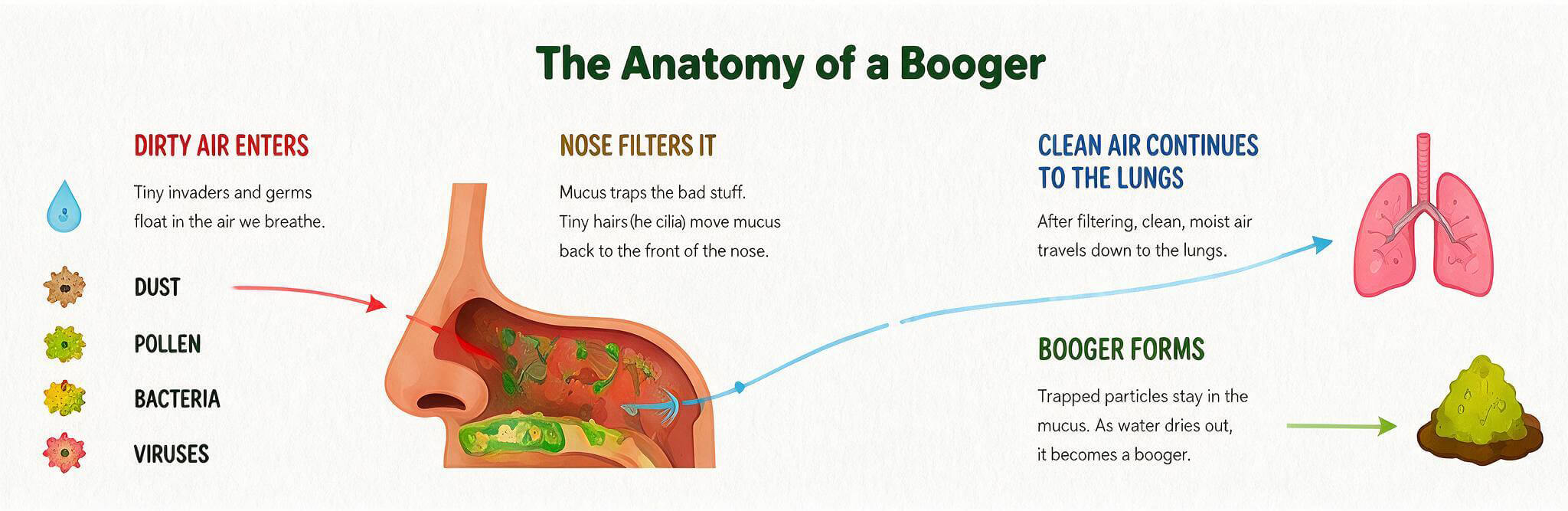
Boogers are made of dried nasal mucus, plus everything that mucus caught on the way in. Mucus is about 95% water mixed with proteins and salt. The rest is whatever your nose filtered out of the air that day: dust, pollen, bacteria, viruses, and dead skin cells.
What Are Boogers Made Of? The 5 Main Ingredients
1. Mucus
This is the base ingredient. Everything else is just stuff that got stuck in it. Mucus is about 95% water mixed with proteins and salt. Picture sticky glue, or a spiderweb strung across the inside of your nose, waiting for something to float by. That is the whole job.
2. Dust and Dirt
Look at the top of a ceiling fan. Look under a bed. That same dust is floating in the air you are breathing right now. Every time your child inhales, some of it gets caught in the mucus instead of going down into their lungs. A good chunk of any booger is household dust that never made it past the front door of the body.
3. Pollen
In spring, plants release pollen, which is the stuff that sets off sneezing fits. Pollen grains are tiny, but mucus catches them anyway. If your kid has been outside all afternoon, their boogers might have little yellow specks in them. That is pollen that got stopped at the door.
4. Germs (Bacteria and Viruses)
This is the gross-but-cool part. Boogers contain real germs that were actively trying to get into your body. The mucus in the nose grabs bacteria and viruses the way flypaper catches flies, and holds them there so they cannot get any deeper. A booger is basically a dead end for germs. Far better in the booger than in the lungs.
5. Dead Skin Cells and Debris
The lining inside the nose sheds old skin cells, the same way skin does everywhere else. Those cells get stuck in the mucus too, along with any other microscopic bits floating around, like smoke or pollution particles. That is what gives boogers their texture.
Free to use on your own site with attribution and a link back to boogerkit.com.
					<a href="https://boogerkit.com/what-are-boogers-made-of/">
  <img loading="lazy" decoding="async"
    src="https://boogerkit.com/wp-content/uploads/2026/04/what-are-boogers-made-of-anatomy-c.jpeg"
    alt="What are boogers made of, anatomy infographic showing how nasal mucus traps dust, pollen, bacteria, and viruses"
    width="2048" height="666"
    style="max-width:100%;height:auto;border:0;"
  />
</a>
<p>Infographic by <a href="https://boogerkit.com/what-are-boogers-made-of/">Booger Kit</a></p>
Do Boogers Have Protein In Them?
Yes. Boogers contain real protein, and this surprises almost everybody. We broke down all five proteins, what each one does, and why nobody has ever measured how much is in a single booger.
Why Boogers Are Actually Helpful
Boogers gross us out. They are also doing real work.
Picture the inside of the nose as a security team, with mucus as the guard on duty. Air comes in through the nostrils. The mucus is sitting there ready to trap the bad stuff, meaning germs, dirt, and allergens, before any of it gets deeper into the airway. When those particles get stuck and the mucus dries, you get a booger holding everything it caught.
In other words, a booger is a sign your nose is doing its job. It acts like a shield for the lungs. Same idea as the lint trap in a dryer or the filter in a vacuum, except it is in your face.
The mucus itself has a second job too. It keeps the inside of the nose moist so it does not dry out and crack, because a dry nose bleeds more easily and lets germs in more easily. Mucus also carries germ-fighting proteins and immune cells that actively attack bacteria. It is not just a passive trap, it fights back.
TRY THIS!
Hold a flashlight near a sunny window and look closely. See all those tiny specks floating in the beam? Some of those end up trapped in your mucus every day. That's what becomes part of a booger!
DID YOU KNOW?
Lysozyme, one of the germ-fighting proteins in your nose, is also in your tears and your spit. Your body stations the same defender at every door.
Why Picking Your Nose Is a No-No
Boogers being helpful inside the nose does not mean anyone should go mining for them with a finger.
We know it is tempting. Kids do it, and plenty of adults do it too. But here is the actual problem with the habit.
It Spreads Germs
Boogers catch germs. That is the whole design. So when a finger goes in there, those germs come back out on the hand and under the fingernails.
Everything touched next picks them up: toys, snacks, doorknobs, a sibling’s face. And it works in reverse too. Dirty fingers carry brand new germs up into the nose. Nose picking turns a finger into a germ delivery service running in both directions.
It Causes Irritation and Injury
The inside of the nose is delicate tissue. Sharp fingernails scratch it. Ever seen a nosebleed right after picking? That is why. Picking irritates or tears the tiny blood vessels inside the nose, which causes bleeding and sores. Frequent picking also makes infection more likely, because those small cuts give germs an easy way in.
It Is Socially Rough
Kids get teased for it at school. Adults get looks. It is a hard habit to break and one that everybody around your child will be grateful you broke.
The fix is simple. Tissue, or a gentle nose blow. That clears the booger and keeps hands clean. Teach kids to reach for a tissue the second they feel something in there. You can make it easier with saline nasal spray.
And About Eating Them
Some kids eat their boogers. We cringed typing that too.
Why? Curiosity, habit, boredom, or simply not having learned yet that other people consider it unacceptable. Sometimes it is just that something in there felt irritating and easy to reach.
If your kid has sampled one, it is not an emergency. Just discourage it calmly. Remind them that boogers are body waste, full of the exact germs their body was trying to get rid of. Boogers are not food.
Fun Facts About Boogers
Mostly Water
Fresh nasal mucus is about 95% water, which is why a booger shrinks so much as it dries.
Different Colors
Colors can be clear, white, yellow, green, red, or dark.
Many Animals
Lots of animals pick their noses too.
You Have a Built-In Conveyor Belt
Tiny hairs called cilia line the inside of your nose and constantly sweep mucus along. They are moving right now, and you cannot feel a thing.
Built-In Defense
Boogers trap germs so your body can stay healthy.
Microscopic World
Boogers contain thousands of tiny particles and germs.
Yellow Specks Are Pollen
Been outside all afternoon in spring? Look closely. Those little yellow flecks are pollen grains your nose caught before they could reach your lungs.
Frequently Asked Questions
What are boogers made of?
Boogers are dried nasal mucus mixed with whatever that mucus trapped. Fresh mucus is roughly 95% water, along with salts, mucins, and protective proteins. As it dries near the opening of the nostril it holds onto dust, pollen, bacteria, viruses, and dead cells shed by the lining of the nose. That clump is what we call a booger.
What are the main ingredients in a booger?
A typical booger contains mucus as the base, plus dust and dirt pulled from the air, pollen, bacteria and viruses, and dead skin cells shed by the nasal lining. The mucus itself is mostly water with salts, mucins that give it a sticky gel texture, and antimicrobial proteins. The rest includes material the nose filtered from the air, along with cells and other debris from inside the nose.
Do boogers have protein in them?
How are boogers formed?
Your nose produces mucus constantly, and tiny hairs called cilia help move it along. When mucus near the opening of the nostril loses enough water, it thickens and dries around whatever it trapped. Low humidity and dry indoor air can speed that process, which is part of why boogers may be more noticeable in winter.
Are boogers good for you?
Boogers are not beneficial themselves, but the process that creates them is protective. Mucus traps dust, pollen, microbes, and other particles before they travel deeper into the airway, and it contains antimicrobial substances that help defend against microbes. A booger is a record of something your nose stopped. That does not make it something to eat or to go digging for.
Are boogers salty?
Yes. Nasal mucus contains sodium, chloride, and other electrolytes, which can give it a salty taste. Those dissolved salts are part of the fluid that keeps nasal mucus hydrated and helps it work normally. As mucus dries into a booger, the water content falls while the salts and other material stay behind.
Do animals get boogers too?
Yes. Many animals produce nasal mucus and can develop dried nasal secretions in or around the nose. The mucus does the same basic job it does in people: trapping particles from the air and helping clear material out of the respiratory tract.
Is it okay to swallow boogers?
Swallowing happens constantly whether you intend it or not. Cilia sweep most nasal mucus toward the back of the throat, where it joins saliva and goes down without you noticing. That is a normal part of how the nose clears mucus. Deliberately picking and eating boogers is different, because nose picking puts fingers into the nasal cavity, can transfer microbes between the nose and hands, and can injure the tissue inside the nose.
Why are boogers different colors?
Boogers can be clear, white, yellow, green, red, or dark. Yellow or green mucus can result from a buildup of immune cells and enzymes involved in inflammation, rather than simply from the germs themselves. Red usually means a small amount of blood from dry or irritated tissue, and dark shades usually reflect inhaled dust or smoke. Color alone is not a reliable way to tell whether someone is sick.
Why do some kids eat their boogers?
Kids may eat their boogers out of curiosity, habit, boredom, or simply because they have not yet learned that other people consider it unacceptable. Nose picking is common in young children, especially when dried mucus feels irritating or is easy to reach. If a child eats a booger, there is usually no reason to panic. Calmly encourage a tissue instead, and explain that mucus catches dust, germs, and other material from the air.
Why is nose picking bad for kids?
Nose picking can transfer microbes between the nose and fingers, and from there to things a child touches. One study found an association between nose picking and nasal carriage of Staphylococcus aureus. Picking can also scratch the delicate lining of the nose, causing bleeding and irritation and potentially creating openings where bacteria can cause infection.
What is the safest way to get rid of boogers?
The safest option for most people is gently blowing the nose into a tissue. That clears the booger without putting fingers into the nose or spreading germs to whatever gets touched next. For a stubborn booger, saline nasal spray or drops can add moisture and soften dried mucus so it is easier to remove. Teach kids to reach for a tissue instead of putting a finger inside the nose.
You Just Learned What's Inside a Booger. Now Imagine Seeing It For Real.
Booger Kit: The hands-on science experiment that helps get kids to stop picking their nose.

About the Author
Sean Stafford is the founder of Booger Kit and a dad who wanted a science experiment that was both fun and meaningful. He created Booger Kit to help kids see the invisible world of germs and understand how their bodies protect them every day.
Read Our Story
Sources
- Akron Children’s Hospital, “What’s a Booger?”
- Scripps Health, “5 Fun Facts About Boogers”
- UnityPoint Health, “What Exactly Are Boogers and Why Do Kids Eat Them?”
- MIT School of Engineering, “Why Do Our Bodies Make Boogers?”
- Healthline, “What Are Boogers?”
- NPR, “Researchers Dig Into Why Nose-Picking Is a Common Behavior”