
How Long Do Germs From Picking Your Nose Live On Surfaces?
You’ve seen it. Mid-dinner. Mid-carpool. Right in the middle of grandma’s FaceTime call. The finger goes up. And no amount of saying “Get your finger out of your nose” is going to stop it.
Here’s what most parents never stop to ask:
How long do germs from picking your nose live on surfaces?
Spoiler: they don’t disappear when the finger comes down. Whatever rides out on that finger lands on the iPad. The doorknob. The TV remote. The little brother’s face. The dog. The lunchbox. The car seat. The shopping cart handle. The sandwich. And some of them stay alive there for hours. A few hang on for days.
Under ideal conditions, some bacteria can double every 20 minutes. That’s how a single germ becomes millions in a matter of hours.
That’s lab math, not couch math. Real-world household surfaces are far less hospitable than a petri dish. But under the right conditions, many bacteria can double in number every 20 minutes, and the math gets big fast. Mucus helps. It gives germs the moisture and nutrients they need to hang on long enough to spread from a finger to whatever that finger touches next.
Mucus is basically a five-star resort for whatever’s living in your kid’s nose. Warm. Wet. Full of nutrients. The second a booger lands on the couch, it’s not just sitting there. It’s hosting a party.
We built Booger Kit for exactly this moment. Not the moment the finger goes up. The moment you realize nothing you’ve said for three years is working and you need them to actually see what’s living in there.
But first, here’s what’s riding on that finger.
Below: 50 of the most common germs that hitch a ride out of a kid’s nose, ranked from “lives in basically every kid” to “rare but worth knowing.” Each one with how long it survives on the stuff your kid touches every day.
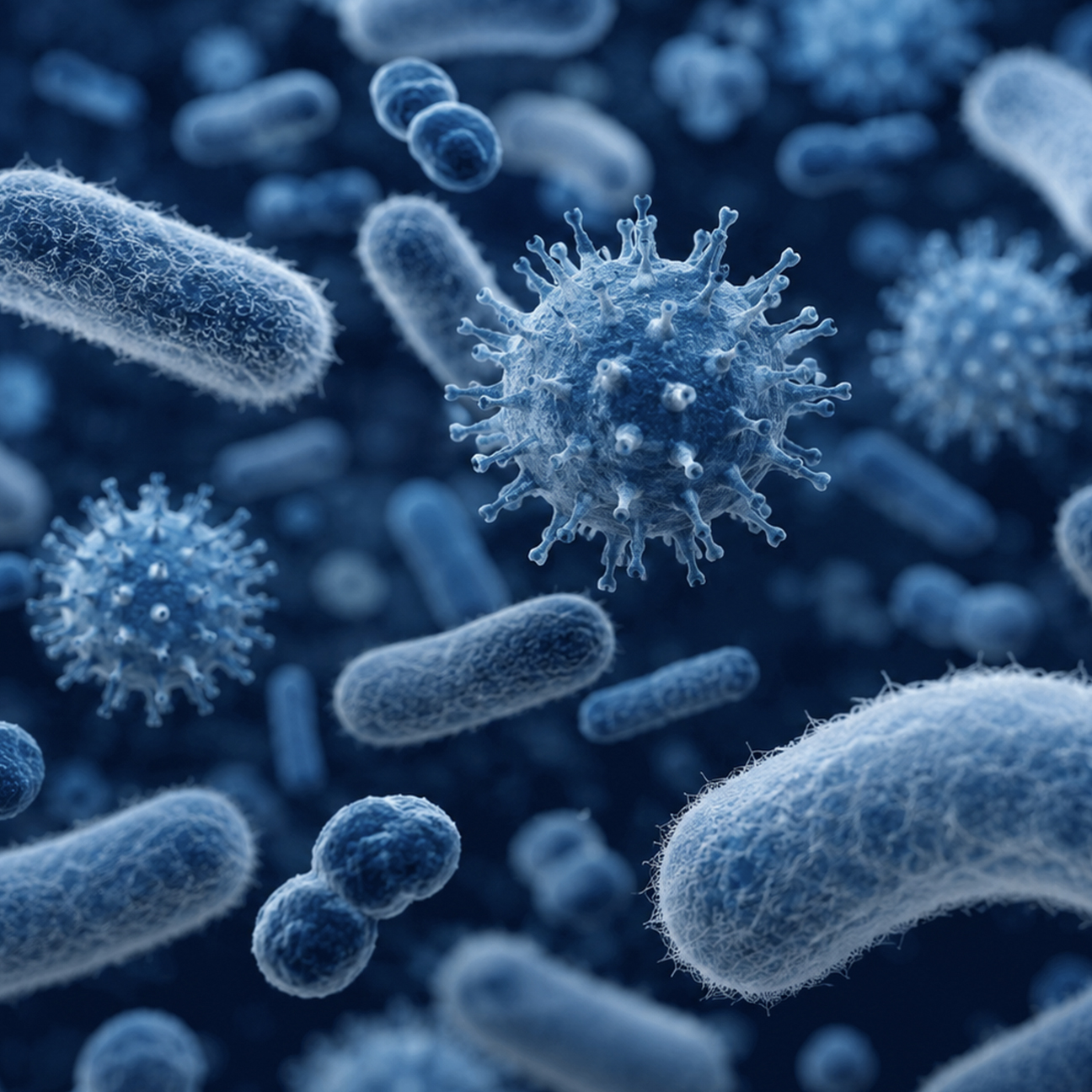
A note before you read this: Most of the germs below are already common parts of normal human environments and don’t usually cause illness in healthy kids. The survival numbers come from controlled studies, often under ideal conditions, and represent the upper end of what’s possible, not what’s typical on your couch. The point of this list isn’t panic. It’s showing how germs move from noses to hands to stuff, so hygiene habits actually make sense to your kid.
How Long Do Germs From Picking Your Nose Live on Household Surfaces?
Germs from picking your nose can survive on household surfaces from a few minutes to several days, depending on the organism and the surface. Cold and flu viruses typically live a few hours to two days on hard surfaces like tablets and doorknobs. Many common nasal bacteria can persist for days under ideal conditions. Soft surfaces like tissues and fabric usually shorten that window. Below is a categorized look at 50 of the most common germs spread by nose picking and how long each one is shown to last.
Key Takeaways
- Germs from picking your nose can survive on household surfaces from minutes to days, depending on the organism and surface type.
- Nasal mucus shields germs and helps them survive longer than germs left exposed.
- Hard surfaces (tablets, doorknobs, remotes, light switches) hold germs longer than porous surfaces (tissues, fabric).
- Most of the germs riding out on a kid’s finger are common in everyday environments and don’t usually cause illness in healthy kids.
- Showing kids what’s actually growing in their nose changes behavior faster than verbal reminders. That’s the whole point of Booger Kit.
The Most Common Germs Living in Kids' Noses
These are the everyday residents. Most are already part of a healthy nose and don’t usually cause illness. But they’re also the ones that ride out on fingers most often.
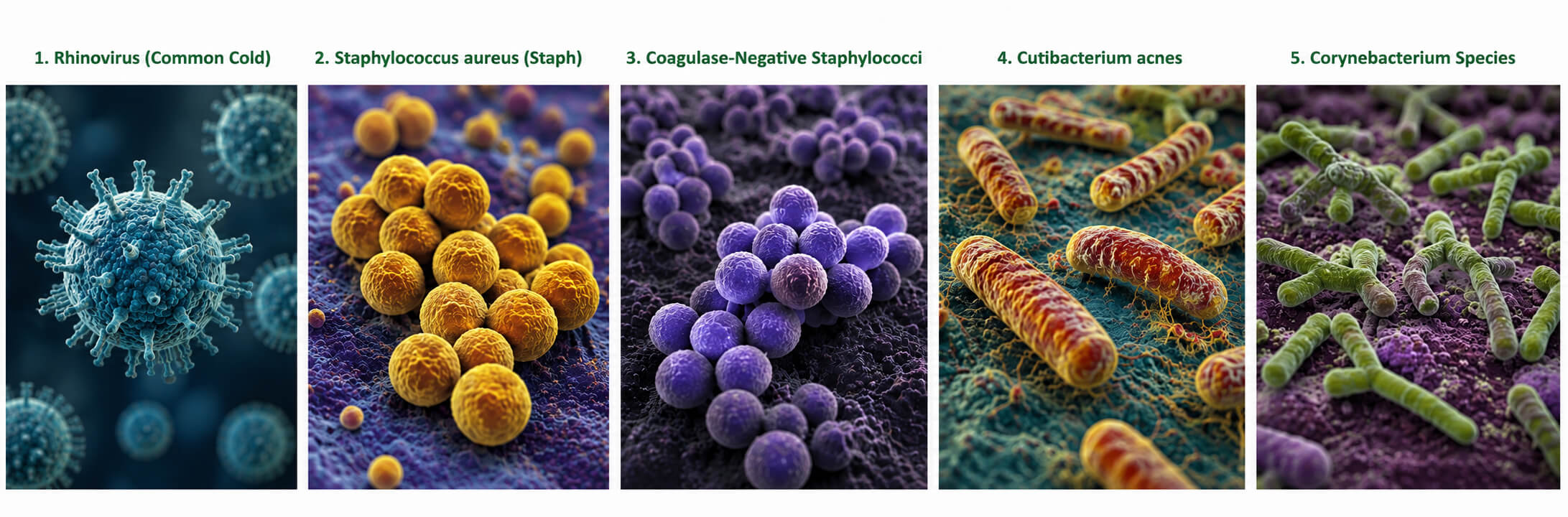
1. Rhinovirus (Common Cold)
Rhinovirus
The king of nose picking. Rhinovirus replicates inside the nose itself, so a finger going in or out is a chauffeur service. Survives at least 4 days on environmental surfaces and stays transferable from objects to fingers for up to 24 hours after contamination.
Doorknobs. Remotes. Refrigerator handles. That’s where I’m waiting. On a dry plastic toy in a warm playroom, I’m set for the week.
2. Staphylococcus aureus (Staph)
Staphylococcus aureus
Already lives in the noses of an estimated 86.9 million Americans (32.4 percent of the population) per the NHANES 2001 to 2002 study. A PubMed study found nose pickers carry significantly more of it than non-pickers. On dry surfaces, controlled studies have shown survival times ranging from 7 days to as long as 7 months under ideal conditions.
I cause skin infections, sinus infections, and pneumonia. My cousins (MRSA, looking at you) laugh at penicillin. Skin, fabric, and dry plastic, that’s where I live.
3. Coagulase-Negative Staphylococci
Staphylococcus epidermidis and relatives
The mellow cousin of Staph aureus. The most common bacteria on human skin and inside the nose, which means most boogers carry them. In controlled studies, gram-positive Staphylococci have been shown to survive for months on dry surfaces under ideal conditions.
Mostly harmless. Mostly. Stick a catheter or a heart valve in someone and we will absolutely cause problems. Hand sanitizer hates us. We do not care.
4. Cutibacterium acnes
Cutibacterium acnes (formerly Propionibacterium acnes)
The acne bacterium. Also colonizes the nasal vestibule and skin almost universally. Lingers on skin and clothing for days.
I live in pores. I live in nostrils. I am why your teenager is moody on picture day. Mostly polite. Get me into a surgical wound and I become a problem.
5. Corynebacterium Species
Corynebacterium spp.
Core member of the healthy nasal microbiome. Coats the inside of every nose and rides out on most boogers. Related species have been shown in studies to survive 7 days to 6 months on dry surfaces under controlled conditions.
Most of us are friendly roommates. We keep meaner germs out of your nose. Wipe us on a doorknob and we’ll sit there for days waiting for someone to give us a ride somewhere weirder.
6. Dolosigranulum pigrum
Dolosigranulum pigrum
A normal nasal microbiome resident, especially in healthy babies and toddlers. Researchers consider it a marker of a healthy nose. Transfers easily on fingers but is fragile in dry air.
The good guy of the nose. I keep the bad guys in check. Every time you wipe me on the wall, you’re weakening team nose. Stop sabotaging your own immune system.
7. Moraxella catarrhalis
Moraxella catarrhalis
A leading cause of ear infections, sinus infections, and bronchitis in kids. One of the first species to colonize infants’ noses. Generally short-lived outside the airway.
Cold air actually makes me stronger, per research on my cold-shock response. Winter is my season. I love the inside of a sniffly nose. I’m why your kid is on amoxicillin again.
8. Streptococcus pneumoniae (Pneumococcus)
Streptococcus pneumoniae
Lives in 53 percent of children aged 6 and under, compared with 4 percent of adults in the same community per Regev-Yochay et al. in Clinical Infectious Diseases. Persists 1 to 20 days on dry surfaces in controlled studies, and a University at Buffalo study published in Infection and Immunity found it living overnight on cribs, books, and stuffed toys in a daycare.
Number one cause of ear infections. Also: pneumonia, sinus infections, meningitis. I love biofilms. I love stuffed animals. I survive long enough to hop from one toddler to the next at story time.
9. Haemophilus influenzae
Haemophilus influenzae
Despite the name, nothing to do with the flu. Lives in the nose and throat. Causes ear infections, sinusitis, and pneumonia. Persists about 12 days on dry surfaces.
Almost half of toddlers carry me at any given time. I don’t survive as long as some of my friends, but I don’t have to. Nose pickers in classrooms get me a fresh ride almost every day.
Common Cold, Flu, and Throat Viruses
The seasonal ones. The ones that move through classrooms and daycares like wildfire. Most spread through respiratory droplets, but contaminated fingers do plenty of the work too.
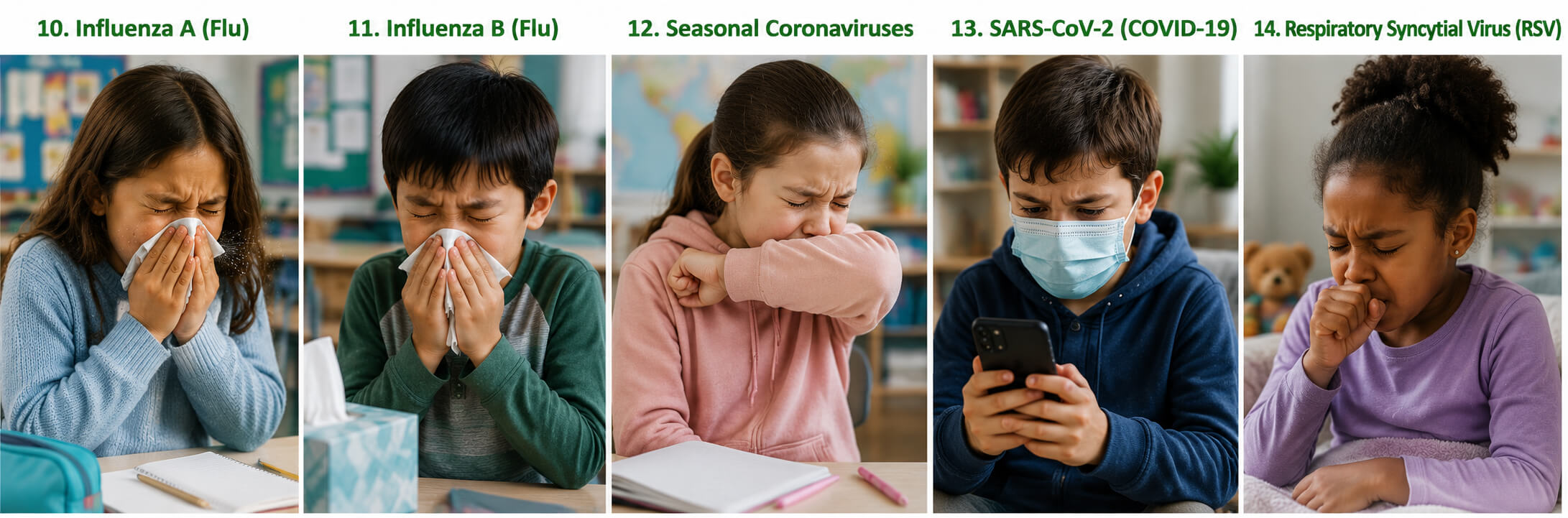
10. Influenza A (Flu)
Influenza A virus
The big winter villain. Has been shown to remain infectious on stainless steel for up to 7 days under ideal humidity in controlled studies, though most real-world estimates land at 24 to 48 hours. On porous surfaces like tissues and clothing, it dies in under 12 hours.
I love metal. I love plastic. I hate copper, sunlight, and dry air. On hands I only get about five minutes, but five minutes is plenty when a kid rubs their eyes.
11. Influenza B (Flu)
Influenza B virus
Influenza A’s wingman. Same playbook, slightly milder, mostly affects kids. Survives 24 to 48 hours on hard surfaces and under 12 hours on cloth or paper.
I don’t get the headlines like Influenza A, but I send plenty of kids to the school nurse. Wipe me off the doorknob today. I’ll be back tomorrow on someone else’s finger.
12. Seasonal Coronaviruses
Human coronaviruses 229E, OC43, NL63, HKU1
The non-COVID coronaviruses cause 15 to 30 percent of all common cold cases per Harrison et al. (2023) in Microorganisms. 229E has been shown to remain infectious on steel, glass, ceramic tile, and PVC for at least 5 days in lab studies, and the broader Kampf review found human coronaviruses can persist on metal, glass, or plastic for up to 9 days under controlled conditions.
I’ve been making people miserable since long before COVID. Stainless steel, plastic light switches, that’s home. Ethanol or hydrogen peroxide finishes me off in seconds. Most parents skip both.
13. SARS-CoV-2 (COVID-19)
SARS-CoV-2
Still in the rotation. Per the landmark NIH/NIAID study published in NEJM, it survives up to 3 days on plastic and stainless steel, 24 hours on cardboard, 4 hours on copper. A Lancet Microbe study found infectious virus on stainless steel and plastic up to 7 days at room temperature.
I’m most at home in your respiratory tract. But I’m happy on a phone screen for days. Add a thin film of mucus and I’m thrilled. Don’t wash your hands? Even better.
14. Respiratory Syncytial Virus (RSV)
Respiratory syncytial virus
The number one reason babies end up in the hospital with breathing problems. Per a classic PubMed fomite study, RSV in infant nasal secretions survived up to 6 hours on countertops, 90 minutes on rubber gloves, 30 to 45 minutes on cloth gowns and tissues, and 20 minutes on skin. Nearly 100 percent of children will be infected with RSV by age 2 per the American Lung Association.
Hard plastic toys. Cribs. High chair trays. That’s my Airbnb. I don’t care about your soap if you don’t use it.
15. Adenovirus
Adenovirus
The toughest cold virus on this list. Per the Public Health Agency of Canada Pathogen Safety Data Sheet, adenoviruses have been shown to persist from 7 days to 3 months on dry inanimate surfaces in controlled studies, and the CDC notes they’re resistant to many common disinfectants.
Colds. Pink eye. Sore throats. Stomach bugs. Hand sanitizer alcohol doesn’t really hurt me because I have no envelope. Soap and water kills me. Soap and water that nobody is using.
16. Parainfluenza Virus (Croup)
Human parainfluenza virus
Cause of croup, the scary barking cough that sends parents to the ER at 2 AM. Survives up to 10 hours on hard surfaces and up to 4 hours on porous materials per the Public Health Agency of Canada.
Door handles, crib rails, light switches. That’s my Airbnb. By age 5, almost every kid has tangled with me.
17. Human Metapneumovirus (HMPV)
Human metapneumovirus
Common but under-recognized. Causes bronchiolitis and pneumonia. Per a PubMed Central study on HMPV environmental stability, it stays infectious on nonporous surfaces for hours but loses viability quickly on paper and fabric.
RSV’s lesser-known sibling who shows up at the same parties. Tissue? I die fast. Plastic crib rail? Plenty of time.
18. Streptococcus pyogenes (Strep Throat)
Streptococcus pyogenes
Causes strep throat, scarlet fever, and impetigo. Per the Kramer systematic review, it survives 3 days to 6.5 months on dry surfaces in controlled studies. The University at Buffalo study found it living on books and stuffed toys overnight in a daycare.
I love biofilms. Once I’ve built one on a stuffed bunny, you basically have to wash that bunny in hot water to evict me. Sentimental? Too bad.
19. Herpes Simplex Virus 1 (Cold Sores)
Herpes simplex virus 1
More than 3.7 billion people under 50 (67 percent of the population) have HSV-1 per the WHO’s first global estimate published in PLOS ONE. HSV-1 can survive on dry inanimate surfaces for up to 7 days under controlled conditions and stays transferable from doorknobs and faucets to fingers for up to 2 hours.
Lick a finger. Pick a nose. Touch a cold sore on your lip. Welcome to the family. Once I’m in, I never leave. I just nap in your nerves until you get stressed.
20. Enterovirus / Coxsackievirus (Hand-Foot-Mouth)
Enterovirus and Coxsackievirus
Hand-foot-mouth is a daycare classic. Per a ScienceDirect study on enterovirus stability, infectivity declines within hours on toy surfaces, but viral RNA can be detected for up to 28 days. The Kramer review groups coxsackievirus with viruses lasting a few days on surfaces.
I’m non-enveloped, so hand sanitizer alcohol is not great at killing me. Soap and water are. Daycare toys are my favorite. Someone always brings me to the next playdate.
Drug-Resistant and Opportunistic Bacteria
These don’t normally cause trouble in healthy kids. They become a problem when they hitch a ride into the wrong place at the wrong time. Several of them now shrug off antibiotics that used to work.
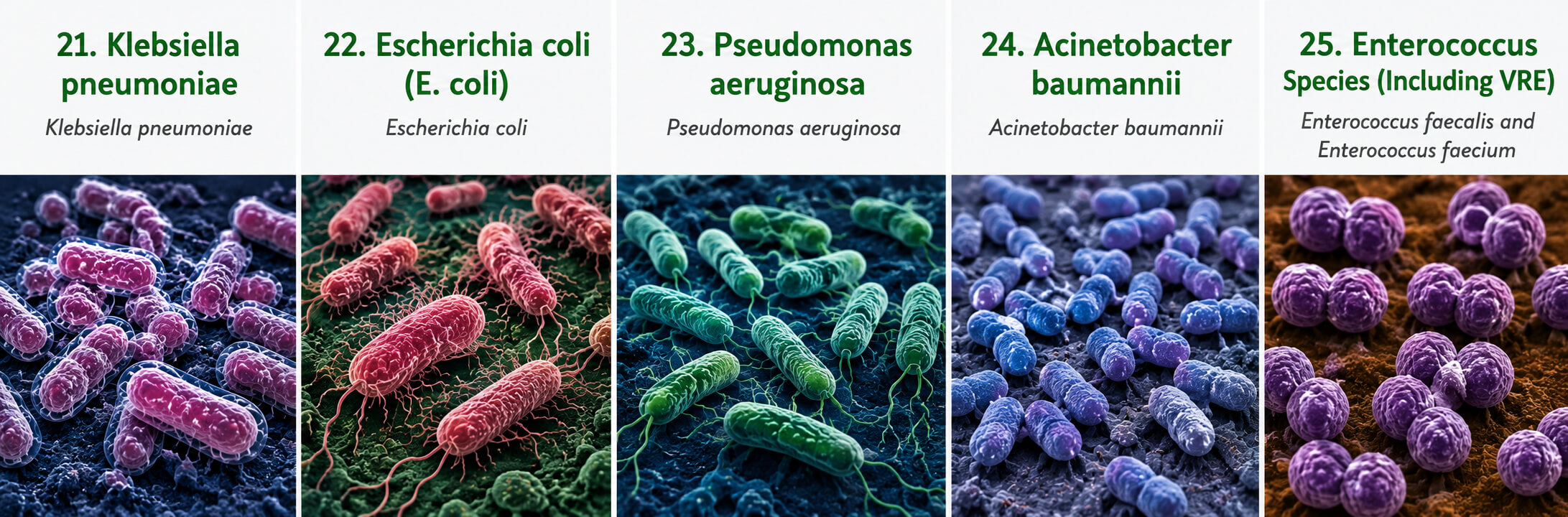
21. Klebsiella pneumoniae
Klebsiella pneumoniae
Lives in respiratory tracts. Causes pneumonia, UTIs, bloodstream infections. Per a 2024 Journal of Hospital Infection scoping review, it has been shown in lab studies to survive up to 600 days on inanimate surfaces under ideal conditions, the longest of any organism in the review.
Some of my cousins are now resistant to almost every antibiotic in the cabinet. Wet sinks. Dry counters. IV bags. I don’t care which.
22. Escherichia coli (E. coli)
Escherichia coli
Yes, the bathroom germ. Also turns up in nasal swabs more often than parents would like. Per the Kramer review, E. coli can survive 1.5 hours to 16 months on surfaces depending on conditions.
I get to noses on fingers that didn’t get washed after the bathroom. I am why “wash your hands” is the oldest pediatric advice on Earth. Skip the wash, send me up the nose. Done.
23. Pseudomonas aeruginosa
Pseudomonas aeruginosa
A nasty opportunist. Per the Public Health Agency of Canada PSDS, Pseudomonas can survive for months on dry surfaces and inanimate objects under ideal conditions. Loves moisture.
Hot tubs. Contact lens cases. Humidifiers. I cause ear infections in swimmers and pneumonia in weak lungs. Some of me laughs at carbapenems now.
24. Acinetobacter baumannii
Acinetobacter baumannii
The ICU’s least favorite roommate. Per the Journal of Clinical Microbiology, it survived an average of 27 days on dry surfaces, and a more recent field study showed it viable for at least 4 weeks on glass, stainless steel, PVC, and aluminum.
Wipe down the table. I’m still there, waiting. Multidrug-resistant. The reason hospital infection control teams have gray hair.
25. Enterococcus Species (Including VRE)
Enterococcus faecalis and Enterococcus faecium
Found in the gut, on skin, sometimes in noses. Per the Kramer review, Enterococcus species survive 5 days to 4 months on dry surfaces in controlled studies.
VRE means vancomycin-resistant. That’s the antibiotic doctors save for last resort. I laugh at it. Months on bed rails. Dry me out, I don’t care.
26. Methicillin-Resistant Staphylococcus aureus (MRSA)
Methicillin-resistant Staphylococcus aureus
Staph aureus’s antibiotic-resistant evil twin. Per Kramer et al. in BMC Infectious Diseases, MRSA survives 7 days to 7 months on hard surfaces under ideal conditions, and a study tracking MRSA in homes found it on video game controllers, towels, and refrigerator handles for months at a time.
Started in hospitals. Now in your gym, your daycare, your kid’s wrestling mat. The nose is one of my favorite hideouts. Pick that nose, touch a scratch, I’m in.
Yeasts and Household Molds
Spores in the air. Fuzz on the grout. Yeast on the skin. Most of these end up in noses because kids inhale them, then those same kids transfer the spores to surfaces with their fingers.
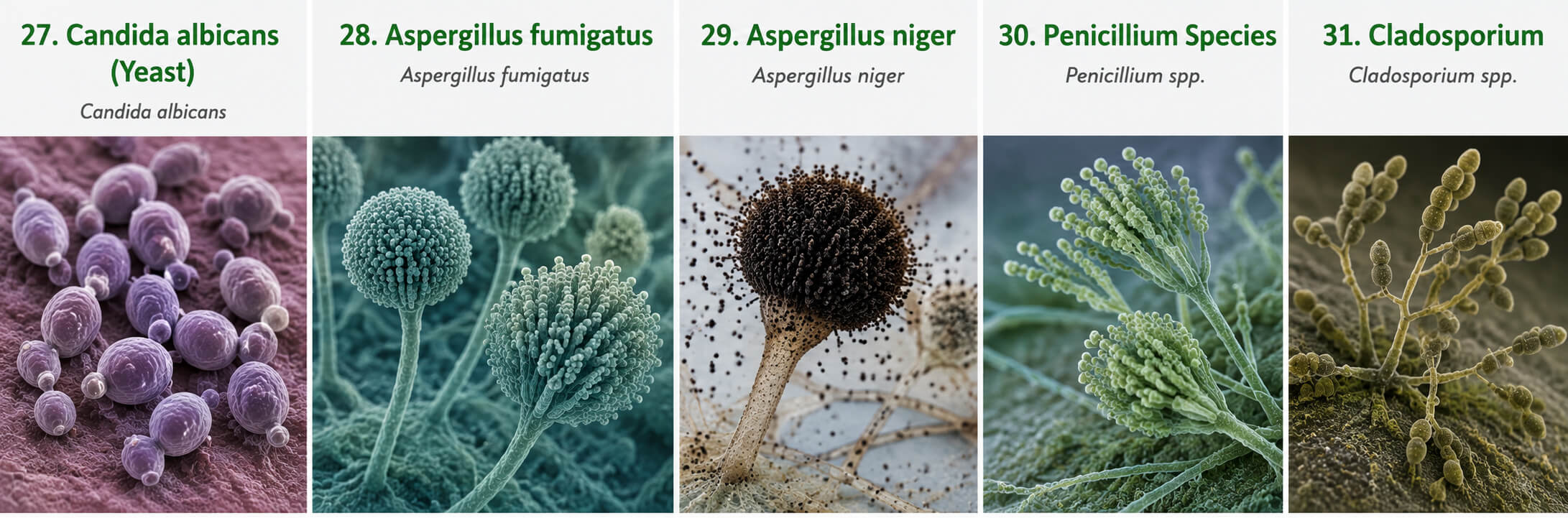
27. Candida albicans (Yeast)
Candida albicans
A yeast that lives on most humans without trouble. Until it doesn’t. Per the Public Health Agency of Canada PSDS, it can survive on inanimate surfaces from 24 hours up to 120 days under controlled conditions.
Thrush in babies, yeast infections in everyone else. I love damp surfaces. Bedsheets. I survive fine on a plastic toy until somebody puts it in their mouth.
28. Aspergillus fumigatus
Aspergillus fumigatus
A common mold whose spores live in dust, soil, and indoor air. Per a PubMed Central narrative review, Aspergillus spores are highly resistant to drying and can survive on surfaces for weeks to months. Thrives anywhere humidity exceeds 55 percent per the Indoor Doctor mold guide.
I’m in the air your kid is breathing right now. They sniff me up, wipe me out, smear me on the chair. I rarely infect healthy lungs but I trigger a lot of allergies and asthma flares.
29. Aspergillus niger
Aspergillus niger
The black fuzz on bathroom grout. Per a PubMed Central study on Aspergillus niger spores, its pigmented spores have thick cell walls that survive drying, UV, even space radiation in lab tests.
Why your shower has black spots. Damp? Love it. Dry? Tolerate it. Bleach kills me. Hand-wave cleaning does not.
30. Penicillium Species
Penicillium spp.
The mold that gave us penicillin. Also the green fuzz on old bread. Per a PubMed Central study comparing indoor molds, Penicillium spores survive for weeks at low humidity but can’t reactivate growth once humidity drops below 75 percent.
Top three mold in indoor air. I trigger allergies. I make the cheese great. My spores ride in noses and end up on every surface in the house.
31. Cladosporium
Cladosporium spp.
The most common mold in indoor and outdoor air. Survives humidity dynamics significantly better than Aspergillus or Penicillium, per a PubMed Central study.
I’m the olive-green to black fuzz on window frames and bathroom walls. I make people with allergies miserable. Inhaled. Blown out. Smeared everywhere. Charming.
Atypical Bacteria and Persistent Viruses
Some of these stay with you for life. Most parents will never see a symptom from them. But they pass through noses and onto household surfaces all the same.
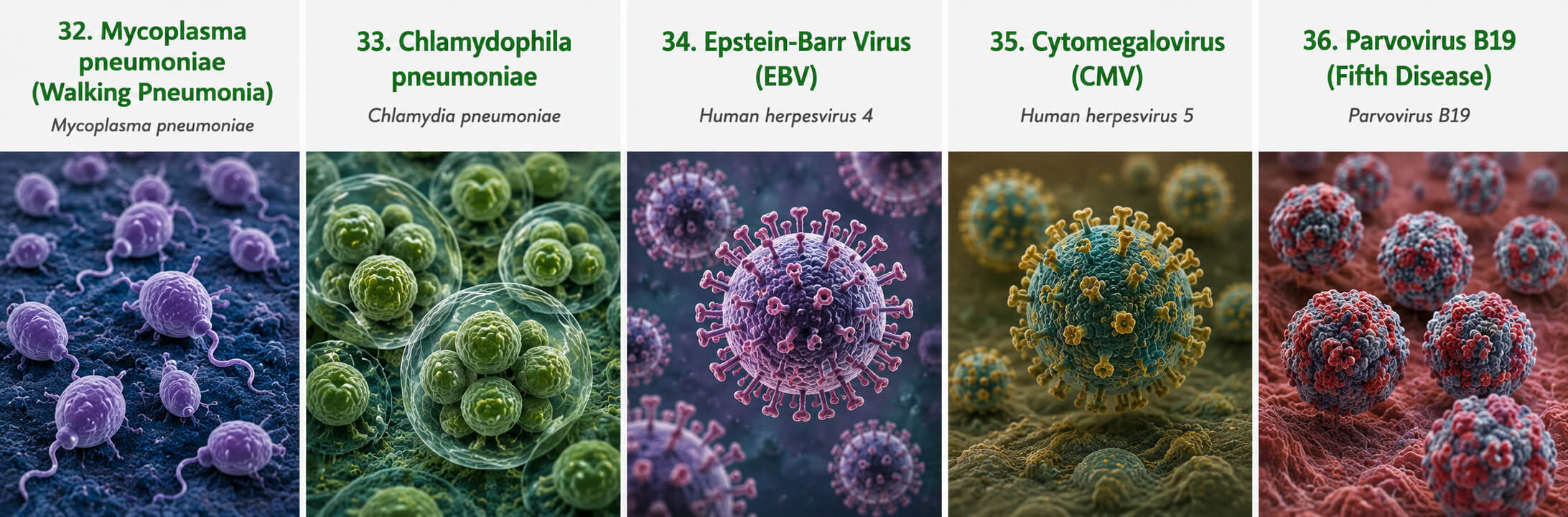
32. Mycoplasma pneumoniae (Walking Pneumonia)
Mycoplasma pneumoniae
Causes “walking pneumonia” in school-age kids. Per the Public Health Agency of Canada PSDS for Mycoplasma, Mycoplasma survives only about 1 hour in liquid specimens and dies quickly on dry surfaces.
Smallest free-living organism on Earth. No cell wall, so penicillin does nothing to me but drying kills me fast. I need close contact. A freshly nose-picked finger is plenty close.
33. Chlamydophila pneumoniae
Chlamydia pneumoniae
Causes pneumonia, bronchitis, and sinus infections. Recently shown in mouse studies to potentially reach the brain via the nasal route. Per the Kramer review, persists 30 hours or less on surfaces.
I’m sneaky. Most infections feel like a cold. I don’t last long on a doorknob. I don’t have to. The nose is my express lane.
34. Epstein-Barr Virus (EBV)
Human herpesvirus 4
The “kissing disease” virus that causes mono. Nearly 95 percent of the world’s adults have been infected with EBV per StatPearls/NCBI Bookshelf. Per the CDC, EBV “probably survives on an object at least as long as the object remains moist.” The Kramer review groups it with herpesviruses surviving a few hours up to 7 days.
Saliva. Nasal mucus. Both my favorite. Mono lasts weeks but I’m with you for life. Once I clock in, I never clock out. I just nap in your B-cells.
35. Cytomegalovirus (CMV)
Human herpesvirus 5
A herpesvirus that infects most adults, usually quietly. Per a PubMed Central study by Stowell et al., CMV remains viable on metal and wood for up to 1 hour, on glass and plastic up to 3 hours, and on rubber, cloth, or crackers for up to 6 hours.
Most people never know they have me. Dangerous mainly to pregnant moms and immunocompromised kids. Dry plastic? I die fast. Damp tissue in a daycare? Plenty of time.
36. Parvovirus B19 (Fifth Disease)
Parvovirus B19
Causes the “slapped cheek” rash in school-age kids. Spread mostly via respiratory droplets and contaminated nasal secretions per Colorado Public Health. Non-enveloped, so environmentally stable for days to weeks.
Tiny. Tough. No envelope, so alcohol-based hand sanitizer struggles with me. By the time the rash shows up, the kid is no longer contagious. Annoying for parents tracking outbreaks.
37. Varicella-Zoster Virus (Chickenpox)
Varicella-zoster virus
Chickenpox and shingles. Per the Public Health Agency of Canada PSDS, it survives in secretions on surfaces for hours, possibly up to 48 hours under favorable conditions. The CDC notes it stays airborne up to 2 hours after an infected person leaves the room.
Extremely contagious in the air. On surfaces, I’m a wimp. Vaccination has knocked me down hard, but I’m still out there in unvaccinated pockets.
Less Common, Vaccine-Preventable, and Environmental Germs
These are the ones most US parents won’t run into thanks to vaccines, plumbing, and basic public health. Worth knowing about anyway, because the ones we vaccinate against are the ones that used to fill hospital wards.
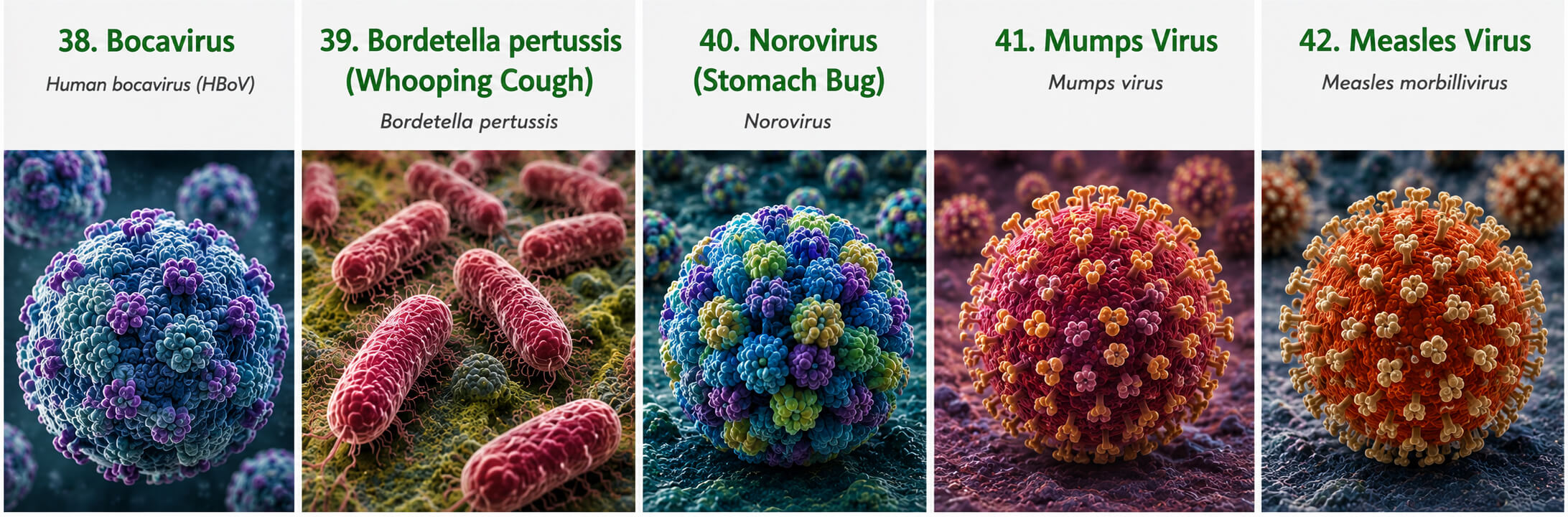
38. Bocavirus
Human bocavirus (HBoV)
Recently discovered respiratory virus causing cold and flu-like illness in young kids. No published controlled fomite-survival studies for HBoV, but as a non-enveloped parvovirus, presumed environmentally stable, with HBoV genomes detected in sewage and surface waters.
Underdiagnosed because hospitals don’t always test for me. I show up with RSV and rhinovirus a lot. Tougher than enveloped viruses. Soap and water beat me. Hand sanitizer is iffy.
39. Bordetella pertussis (Whooping Cough)
Bordetella pertussis
Cause of whooping cough. Persists only 3 to 5 days on dry surfaces per the Kramer review. Short for a bacterium.
I’m why babies get the DTaP shot. The whoop is the sound of a kid struggling for breath after a coughing fit. I rely on rapid spread. Nose pickers in classrooms are excellent help.
40. Norovirus (Stomach Bug)
Norovirus
Mostly a stomach bug, but per Cleveland Clinic it lives on hard surfaces like plastic for more than 2 weeks. CDC research notes it can persist 21 to 28 days at room temperature.
Cruise ship virus. Daycare nightmare. Hand sanitizer barely affects me. Bleach kills me. Twenty viral particles, that’s all I need to make a kid sick. Bring it.
41. Mumps Virus
Mumps virus
MMR-preventable swollen-glands virus. Per University of Connecticut Health, mumps can survive on contaminated surfaces like doorknobs, with length varying by conditions.
I make your face puff up like a chipmunk. Don’t last long outside a host. In unvaccinated communities, I make a comeback regularly.
42. Measles Virus
Measles morbillivirus
One of the most contagious viruses on Earth. Per the CDC and WHO, measles can remain infectious in the air or on surfaces for up to 2 hours after the infected person leaves.
One person with me infects up to 18 others, per WHO. That’s not normal. That’s supervillain-level contagious. Vaccinated kids? I bounce off. Unvaccinated kids? I find them fast.
43. Rubella Virus (German Measles)
Rubella virus
The “German measles” virus. Per the Public Health Agency of Canada PSDS, a half-life of about 1 hour at body temperature and a mean survival time of roughly 0.9 days outside the host.
Mostly mild. Disaster for unborn babies. Why MMR exists. Don’t survive long on a doorknob. Long enough on a finger going from nose to face.
44. Mycobacterium tuberculosis (TB)
Mycobacterium tuberculosis
TB: Still one of the world’s deadliest diseases. Per the Public Health Agency of Canada PSDS, TB has been shown in studies to survive months on dry surfaces, 19 days in sputum on carpet, and over 88 days on wood under ideal conditions.
Rare in the US. Common globally. UV light kills me. Darkness extends my life dramatically. My waxy cell wall laughs at most disinfectants.
45. Neisseria meningitidis (Meningococcus)
Neisseria meningitidis
Causes meningococcal meningitis, the kind teenagers get vaccinated against. Per Tzeng et al. in PubMed Central, viable meningococci have been recovered for up to 72 hours on plastic, glass, and metal after desiccation.
I live quietly in some people’s noses. Then sometimes I don’t. I move fast in close quarters like dorms and barracks. Kissing, sharing drinks, nose picking, all spread me.
46. Corynebacterium diphtheriae
Corynebacterium diphtheriae
Causes diphtheria. Used to kill thousands of kids before the DTaP vaccine. Per the Public Health Agency of Canada PSDS, it can survive on dry inanimate surfaces from 7 days to 6 months under controlled conditions.
Rare in vaccinated countries. Roaring back in others. I form a thick gray membrane in the throat that can suffocate kids. The vaccine works really, really well. Don’t skip it.
47. Clostridium difficile (C. diff)
Clostridioides difficile
Mostly known for gut infections. Spores travel everywhere on hands. Per Northwestern Medicine and a PubMed Central study, C. diff spores can survive on hard inanimate surfaces for up to 5 months under ideal conditions and resist most hospital disinfectants.
I’m a spore. Alcohol gel? Doesn’t bother me. Most disinfectants? Doesn’t bother me. Bleach finishes me. Bathroom to nose to doorknob is my favorite commute. Half a year minimum.
48. Legionella pneumophila (Legionnaires’ Disease)
Legionella pneumophila
Causes Legionnaires’ disease. Per the Public Health Agency of Canada PSDS, it can survive up to 139 days in distilled water and up to 415 days in tap water in lab studies. Persists in plumbing biofilms for years.
I don’t really live on dry doorknobs. Showerheads. Hot tubs. AC cooling towers. You inhale me from mist. Nose picking is a bit player in my world, but contaminated water on a hand is enough.
49. Serratia marcescens (Pink Slime)
Serratia marcescens
The orange-pink slime in shower grout and toilet tanks. Per the Kramer review, survives 3 days to 2 months on surfaces under controlled conditions. Occasionally turns up in respiratory cultures.
I make pretty pink stains. I cause pneumonia in hospitals. Damp surfaces and biofilms. Catch me on a finger after a sink encounter, send me up a nose. Lovely.
50. Stenotrophomonas maltophilia
Stenotrophomonas maltophilia
A multidrug-resistant gram-negative bacterium that occasionally colonizes the respiratory tract, especially in cystic fibrosis patients. Survives weeks on surfaces under the right conditions per the broader Kramer survey.
Rare in healthy kids. Real headache in immunocompromised ones. Most antibiotics don’t touch me. I love wet surfaces, water taps, and ventilator tubing.
What Parents Should Actually Do About Nose Picking Germs

Kids aren’t trying to be gross. They just touch their face more, wash their hands less, and share everything they own. If you want to actually cut down on the germs riding out of your kid’s nose and onto everything they touch, here’s where the effort pays off.
1. Reduce the physical triggers
A lot of nose picking is caused by dry, irritated, or congested noses. Saline spray, a humidifier in the bedroom, allergy treatment if it applies, and just keeping kids hydrated all reduce the urge in the first place.
2. Replace the behavior, don’t just punish it
Hand them a tissue without a lecture. Make tissues easier to reach than fingers. Reward the swap, not the abstinence. Behavior swaps stick. Shame doesn’t.
3. Make hand washing automatic
Before meals. After screen time. After playdates. After daycare pickup. Soap and water beat hand sanitizer for non-enveloped viruses like adenovirus and norovirus, which alcohol doesn’t fully kill.
4. Wipe down the actual transfer points
iPads. Tablets. TV remotes. Video game controllers. Doorknobs. Light switches. Refrigerator handles. Bathroom faucet handles. Lunch boxes. Stair railings. Couch armrests. The phone case your kid is always holding. The fancy expensive cleaning products aren’t required. Disinfecting wipes a few times a week on the high-touch stuff cuts the transfer chain at its weakest link.
5. Make the invisible visible
This is the one nobody tells you about. The reason every other strategy fails is that the consequences of nose picking are invisible to a kid. Make them visible, and the behavior changes on its own.
That’s exactly what we built Booger Kit to do.
Why Kids Spread More Germs After Picking Their Nose
When a kid picks their nose, they’re not thinking about what’s on their finger. Because they can’t see it. They can’t see bacteria. They can’t see viruses. They can’t see contamination spreading from their hand to the iPad to their little sister’s snack.
The consequences are invisible.
And that’s why “stop picking your nose” doesn’t work no matter how many times you say it. The lecture is abstract. The behavior is automatic. Words can’t compete with a finger that already knows what to do.
What does compete? Visual evidence. The kind a kid can’t unsee.
You've Tried Everything Else
The lectures. The wipes. The reminders. The “do you want to be sick on your birthday?” pitch.
Nothing sticks.
That’s because telling a kid about MRSA is like reading them a tax return. The words don’t land. The behavior doesn’t change.
Booger Kit is the moment that does.
Your kid swabs their own nose. The sample goes onto a real agar petri dish. The dish gets sealed shut at three points and never opens again. The shipping box becomes the incubator.
By Day 3, specks. By Day 5, dots. By Day 7, full-on biological theater. Yellow blobs. Green fuzz. Pink dots. All of it grew from a single swab from inside their own nose.
That’s the moment. That’s when “stop picking your nose” stops being your line and starts being their thought.
You’ve yelled it 5,000 times. Booger Kit makes them say it once. To themselves.
Real Science. Real Bacteria. Real Behavior Change.