
How to Get My Kid to Stop Picking Their Nose: A Parent’s Guide That Actually Works
Key Takeaways
- You are not alone. Roughly 91 percent of adults admit to picking their nose, and adolescents do it about four times a day on average.
- Saying “stop picking your nose” does not work because the consequences of picking are invisible to your child. Verbal correction registers as background noise within days.
- Behavior change in kids requires understanding, not commands. Research shows children who arrive at conclusions through their own experience change behavior more durably.
- The most effective approach combines three things: addressing physical triggers, replacing the behavior, and showing the child what is actually living in their nose.
- The 10-day plan in this article works for most kids ages 5 to 10. Adapt the strategies for younger or older children using the age-by-age guide below.

You have said “stop picking your nose” so many times you have lost count. The gentle reminders. The stern looks. The “do you know what lives in there” conversation. Maybe even bitter polish or a thumb cover. And here you are, still searching, because none of it stuck.
If you have been searching how to get my kid to stop picking their nose hoping to finally find something that works, this article is for you.
Below is a real plan that targets the actual reason kids pick their nose, not just the behavior. It is built on peer-reviewed research and structured so you can start tonight. No fluff, no shame, no tricks that fail in three days.
First, You Are Not Alone: How Common Is Nose Picking in Kids?
Before anything else: this habit is essentially universal. Your kid is not weird. You are not failing. The numbers tell the real story.
Why "Stop Picking Your Nose" Has Never Worked (And Never Will)

- The consequences are invisible. Kids understand “do not touch the stove” because the stove burns. Nose picking has no visible consequence. The germs are too small to see. The illness comes days later, if at all. The connection between cause and effect is not obvious to a child’s brain.
- The reward is immediate and physical. The nose itches or feels dry. Picking provides relief in seconds. The habit is reinforced every single time it happens. Verbal warnings pale next to physical sensation, and your child’s brain knows it.
- Aversive methods adapt. Bitter nail polish stops tasting bitter after a few days. Thumb covers get lost. Sticker rewards become invisible after a week. Children’s brains are built to tune out repeated stimuli that do not actually matter. Aversive deterrents stop mattering fast.
What Behavior Science Says About How to Get Kids to Stop Picking Their Nose
A 2024 study on toddler cooperation found that autonomy-supportive parenting (helping a child understand the situation and giving them a role in the solution) produced significantly better behavior change than commands or punishment. Separately, hygiene research has shown that vivid, memorable, even disgust-inducing demonstrations produce dramatically better hand-washing behavior than neutral education.
Translation: Showing beats telling. Doing beats listening. Discovery beats dictation.
If you have typed how to get my kid to stop picking their nose into a search bar tonight, this is the answer most parenting sites will not give you. The methods that actually work are not deterrents or tricks. They are tools that help your child see and understand what you have been trying to tell them.
This is also why nose picking specifically is so hard to extinguish through verbal correction. The bacteria that makes nose picking a hygiene problem is invisible. A 2022 study published in JAC-Antimicrobial Resistance found something remarkable about that bacteria:
14X Staph
Your child cannot see that. They cannot intuit it. They have to be shown. If you want the actual peer-reviewed research, we keep it all in one place at the science behind Booger Kit.
How to Get My Kid to Stop Picking Their Nose: 7 Strategies That Actually Work
Here is your toolkit. Some of these work alone. The combination is far more powerful than any single tactic.
Strategy 1: Address the Physical Cause First
Most habitual nose picking starts with a physical trigger: dryness, allergies, or an itchy nose. If you treat the cause, the habit often weakens on its own. Saline nasal spray, a humidifier in the bedroom, and an allergy check-up can resolve a surprising amount of nose picking before behavior interventions even start.
Run this checklist tonight: Is the air in your house dry, especially in winter? Has your child had unaddressed seasonal allergies? Have they had a recent cold that left lingering crusty mucus? Any “yes” answer is a physical lever you can pull immediately.
Strategy 2: Replace the Tool, Not the Behavior
Hand a tissue. Quietly. Without comment. Every single time you see the finger going up. Do this for a week. The brain rewires faster when you give it a substitute behavior than when you try to extinguish the original behavior with willpower alone.
This works because you are not asking the child to stop a behavior. You are giving them a better way to accomplish what the behavior was for. The nose still feels uncomfortable. The tissue still solves the problem. Just without the bacteria delivery system.
Strategy 3: Make the Invisible Visible
This is the strategy that separates families who break the habit in two weeks from families still fighting it next year.
A child who can see the bacteria that lives in their own nose, in a real petri dish, with their own hands, will form a memory that no lecture can match. This is why we built Booger Kit. The science kit lets your child swab their own nose, grow real bacteria over 7 to 10 days, and then have a conversation grounded in something they can actually point to.
More on this in a moment. For now, just know that this single intervention does more than the next four combined.
Strategy 4: Build a Tissue-First Habit Loop
Every time your child picks their nose successfully, the habit gets reinforced. So you flip the loop. Praise them, briefly and specifically, every time you see them use a tissue instead. “Hey, nice job grabbing a tissue.” That is it. Three seconds. Do not make it weird. Repeat 50 times. This is how habit loops actually rewire.
Specificity matters more than enthusiasm. “Good job” is too generic for your child’s brain to encode as a meaningful signal. “I noticed you used a tissue at dinner” lands. The brain registers what gets specifically named.
Strategy 5: Run a Calm “What Happens When” Conversation
Once a week, sit down for two minutes and talk through one specific consequence. Not a lecture. A conversation. Examples:
“What do you think happens to the germs after you pick your nose? Where do they go next?”
“If your hands have boogers on them and you touch a doorknob, what happens to the next person who touches that doorknob?”
Let your child do most of the talking. The goal is to have THEM articulate the consequence. That is when it becomes their belief instead of your rule.
Strategy 6: Use Strategic Distraction
Most nose picking happens during boredom or screen time. If you cannot eliminate those triggers (and you cannot), give the hands something else to do. Fidget toys, drawing, building blocks, even a stress ball, anything that occupies the hands. This is harm reduction more than habit change, but it dramatically lowers daily picking frequency, which gives your other interventions a chance to work.
Pay attention to the specific times your child picks most often. TV time? Long car rides? Right before bed? Each one needs its own distraction strategy.
Strategy 7: Celebrate Small Wins Aggressively
How to Stop Nose Picking by Age (Toddler vs. Elementary vs. Older Kid)
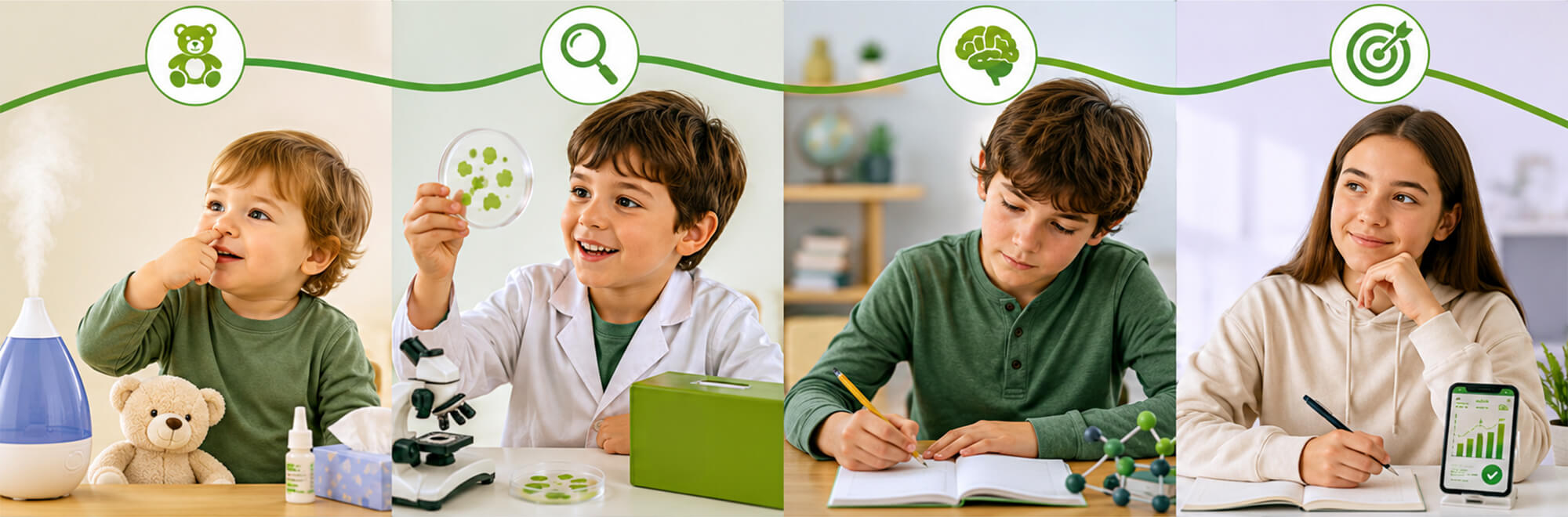
Ages 2 to 4: The Toddler Years
Ages 5 to 7: The Sweet Spot
Ages 8 to 10: The Logic Age
Ages 11 and Up: The Self-Conscious Stage
What NOT to Do When Trying to Stop Your Kid From Picking Their Nose

Do Not Shame Them in Public
Do Not Use Punishment as the Primary Tool
Do Not Pile On Multiple Interventions At Once
Do Not Make It a Power Struggle
Do Not Give Up After a Bad Day
Booger Kit vs. Other Anti-Nose-Picking Methods (Comparison Table)
| Method | Cost | Time to Work | Long-Term? | Why It Works or Fails |
|---|---|---|---|---|
| "Stop picking your nose" lectures | Free | Never | No | Verbal warnings register as background noise. Kids tune them out within seconds. |
| Bitter nail polish | $10 to $15 | 1 to 2 days | No | Children habituate to the taste within days. Habit returns when polish wears off. |
| Thumb covers / finger guards | $10 to $20 | Sometimes | No | Gets removed or lost. Treats the symptom, not the underlying behavior. |
| Saline nasal spray | $5 to $10 | 1 to 2 weeks | Sometimes | Addresses physical triggers like dryness. Best used alongside behavior interventions. |
| Sticker / reward chart | Under $5 | Variable | Sometimes | Works briefly but rewards lose impact. Does not build understanding. |
| Booger Kit | $24 | 7 to 10 days | Yes | Makes invisible bacteria visible. Child internalizes the lesson through their own experience. |
How Booger Kit Fits Into Your Plan to Stop Nose Picking
Here is the part most parenting articles will not tell you, because they are not selling anything.
Of all the strategies above, the one with the highest behavior-change leverage is making the invisible visible. Every other strategy works better AFTER your child has seen, with their own eyes, what is actually living in their nose.
Booger Kit is the only product specifically designed to do that. Your child swabs the inside of their own nostril, plates the sample on agar, seals the dish with the included safety strips, and watches real bacteria colonies grow over a week. They name the colony. They observe it daily. They do the science. Read more about how it works.
Then you have the conversation. Not “stop picking your nose,” but “look what was in there.” Different conversation. Different result.
The kit ships with everything needed: 2 petri dishes with agar, 2 sterile swabs, gloves, fastening strips, labels, disposal bags, and a step-by-step illustrated guide. Adult supervision required. Designed for kids 5 and up.
You can order Booger Kit here for $24 with free shipping in the US.
How to Get My Kid to Stop Picking Their Nose in 10 Days: A Step-by-Step Plan
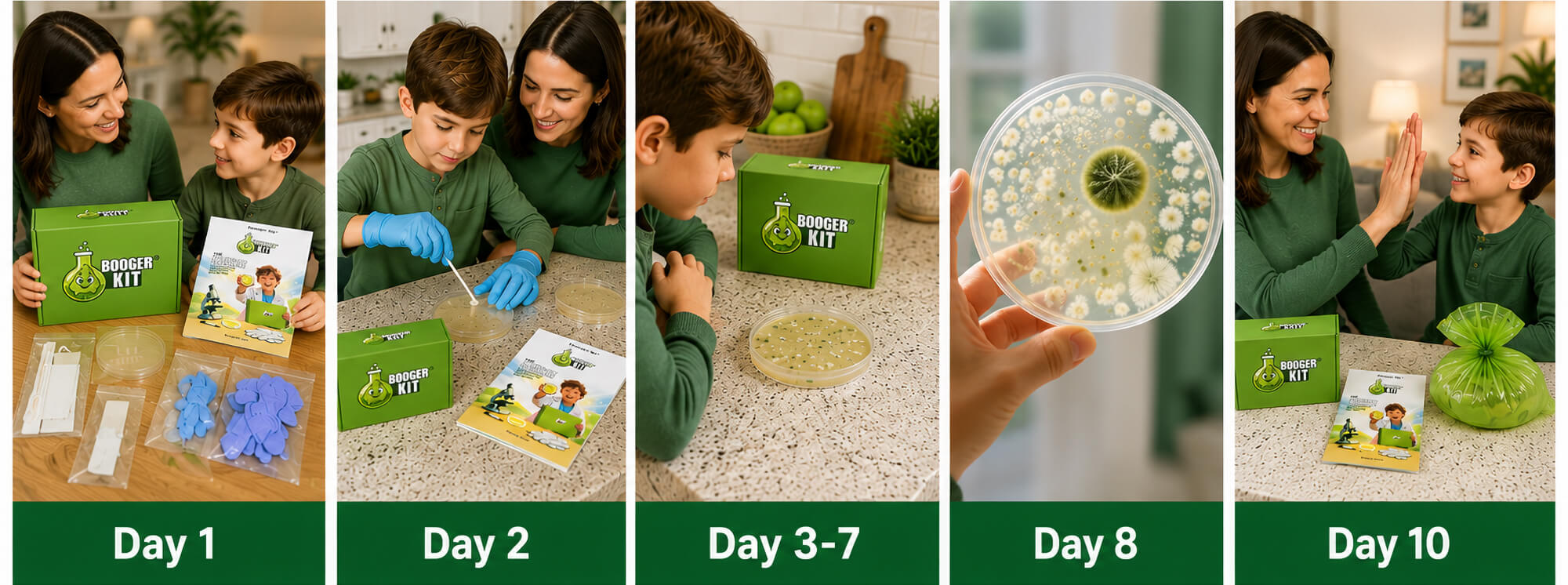
Day 1: Setup and First Conversation
Day 2: Run the Booger Kit Experiment
Days 3 to 7: Daily Check-Ins
Look at the dish together every day. Take a photo. Talk about what is changing. Use the notes pages in the kit. Continue the tissue handoff. Praise specifically when you see your child resist the urge to pick. By day 5 or 6, the colonies should be obvious. By day 7 or 8, things get visibly gross.
Day 8: The Big Conversation
Day 10: Disposal and Reinforcement
Properly dispose of the dish using the included disposal bag. Frame it as a science experiment your child completed. Praise them for being a real scientist. Reinforce the connection: “Now you know what is in there.”
Real Scenarios: What to Say When You Catch Your Kid Picking
Scenario 1: At the Dinner Table
Most parents: “Get your finger out of your nose right now.”
Better: Hand them a tissue without saying anything. Move on.
Best: Hand the tissue silently in the moment. After dinner, casually ask: “I noticed you were picking earlier. What does your nose feel like when you do that?” The post-event question, with no judgment, builds awareness without shame.
Scenario 2: While Watching TV or on a Tablet
Most parents: “How many times do I have to tell you?”
Better: Hand them a fidget toy or a tissue. No comment.
Best: Pause the screen for 30 seconds. “Hey, your hands are doing that thing again. Want to draw with me for a bit?” Boredom-driven picking responds best to redirected attention, not correction.
Scenario 3: In Public or at School Pickup
Most parents: Loud public correction or visible embarrassment.
Better: Quiet tissue handoff. Address it later in the car.
Best: Tissue handoff in the moment, then in the car: “Did you notice yourself doing that thing earlier? What was going on?” Curiosity, not correction, builds metacognition. Avoid shaming in front of peers at all costs.
Scenario 4: Right Before Touching Food
Most parents: “You just picked your nose, do not touch that!”
Better: “Hands need a wash before food. Let’s go.” Move them to the sink. No further comment.
Best: Same redirect, plus a quick connection back to their experiment: “Remember what was growing in our dish? That is what is on your hands right now. Quick wash, then we eat.” The reference to the petri dish makes the abstract concrete.
When to Call the Pediatrician About Nose Picking
Nose picking is almost always a normal childhood habit, not a medical issue. But there are a few situations where a quick call to the pediatrician is worth it:

Frequent or heavy nosebleeds. Occasional minor nosebleeds from picking are common. Frequent or significant bleeding is worth getting checked, both to rule out other causes and to address the local irritation.
Visible damage or scabbing inside the nostril. If you can see raw or scabbed tissue inside your child’s nose, the picking has crossed into a tissue-damage zone that may need medical attention.
Compulsive picking that seems anxiety-driven. If your child picks constantly, especially during stressful moments, and seems unable to stop even when they want to, the habit may be functioning as a self-soothing behavior linked to anxiety. A pediatrician can help you figure out next steps.
Persistent congestion or unusual discharge. If your child seems to always have a runny or congested nose, allergies or sinus issues may be driving the picking. Treating the underlying condition often dramatically reduces the habit.
Picking that persists despite consistent intervention. If you have run a full plan like the one above for several weeks with no progress, your pediatrician may want to look at sensory or developmental factors.
Frequently Asked Questions
At what age should I start trying to stop my kid from picking their nose?
Is it bad for my kid to pick their nose?
Why does my kid pick their nose so much?
Does bitter nail polish work to stop nose picking?
How long does it take to break a nose picking habit in a child?
Most parents see noticeable reduction within two to three weeks of using a combination approach: addressing physical triggers, providing a tissue substitute, and creating a memorable consequence experience like Booger Kit. Full habit elimination can take one to three months. Children who only experience verbal correction often never break the habit during childhood.
Will yelling at my kid for picking their nose make them stop?
Can nose picking be a sign of anxiety in children?
Stop Saying "Stop Picking Your Nose"
You have read this far because the old approach was not working.
The honest answer to how to get my kid to stop picking their nose is not a single product or magic trick. It is a combination of strategies that work together: address the physical triggers, replace the behavior, make the invisible visible, and have the right conversation at the right moment.
Here is the short version of what does work:
- Address the physical triggers tonight. Humidifier, saline, allergies.
- Hand a tissue every time the finger goes up. Quietly.
- Run the science experiment. Show your child what is actually in there.
- Have the conversation grounded in what they saw, not what you said.
The 10-day plan takes ten days. The lesson lasts years.
Order Booger Kit here and turn the next conversation about hygiene into one your child will actually remember.