
The Science Behind Booger Kit
Every time we say “studies show” or “research has found” on our website, we mean it. This page is where we show the science behind Booger Kit.
Below is a walk through every science claim we make across BoogerKit.com, the peer-reviewed studies behind each one, and a short summary of what the research actually says. No hand-waving. No invented stats. If you came here from a link on one of our pages, scroll to the section that matches and you’ll find the source material we built that claim on.
Now let’s talk about what’s actually living in your kid’s nose.
TL;DR: What the Research Actually Says
The short version, with the receipts:
- Frequent nose pickers are 14.6 times more likely to carry Staphylococcus aureus in their nose than non-pickers, according to a 2022 study in JAC-Antimicrobial Resistance (Lamichhane et al.).
- Nose picking is nearly universal in kids. A published adolescent survey found almost every participant admitted to it, at a median of about four times per day. Roughly one in four reported occasional nosebleeds from the habit.
- Boogers are not random gunk. They are dried nasal mucus mixed with the dust, pollen, bacteria, and viruses your nose trapped before they could reach your lungs. The system that produces them is called mucociliary clearance, and it is one of the body’s primary airway defenses.
- Mucus is an active immune weapon, not a passive trap. It contains lysozyme (which breaks down bacterial cell walls), lactoferrin (which starves bacteria of iron), and beta-defensin 2 (an antimicrobial peptide). Your nose is fighting back before you even notice.
- The nose-to-finger-to-everything pipeline is real. Peer-reviewed research has documented household transmission of Staph aureus through hand contact with surfaces, devices, and family members. The CDC identifies hand-to-surface contact as a primary route for everyday illness spread.
- Showing beats telling. Child development research confirms that kids change behavior more reliably through structure, autonomy, and vivid evidence than through repeated commands. A landmark hand hygiene study found that disgust-based messaging outperformed neutral education by a wide margin. Translation: a petri dish on the kitchen counter does what a thousand reminders cannot.
- Bottom line for parents: The nose is doing its job. The problem is what happens when fingers get involved. Booger Kit is built on the principle that you cannot lecture a child out of an invisible habit. You have to make it visible.
[Want the full sources? Jump to the Full Reference List for all 13 peer-reviewed sources.]
A booger is not random gunk. It is a small, dried-out record of what your nose stopped before it could reach your lungs.
Your nasal passages are lined with a sticky mucus layer that traps inhaled dust, pollen, allergens, viruses, and bacteria. Tiny hair-like structures called cilia then sweep that mucus, particles and all, out of the airway. Scientists call this whole system mucociliary clearance, and it is one of the body’s most important first-line defenses. When that mucus dries out near the front of the nose, you get a booger.
A 2023 review published in PubMed details how mucociliary clearance traps inhaled particles and removes them from the upper airway, framing it as the airway’s primary mechanical defense. Read the mucociliary clearance review.
A separate study on nasal mucosal biology identified the key mucin genes responsible for the gel-like, sticky structure of nasal mucus, helping explain why mucus is so good at trapping particles in the first place. Read the mucin expression study.

Boogers are dried-out mucus mixed with whatever your nose caught for you. They are evidence your nose is doing its job.
Mucus Is Your Body's Frontline Defense
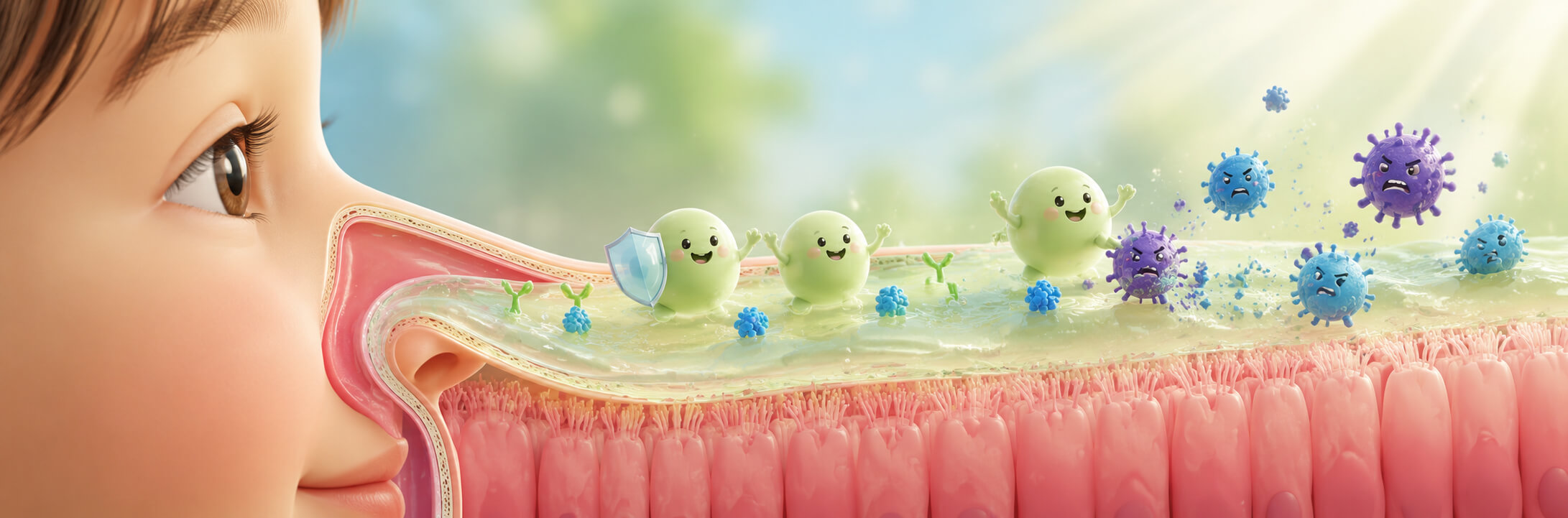
Mucus is not just a passive trap. It is loaded with antimicrobial proteins that actively attack bacteria and viruses on contact.
Researchers studying human nasal secretions have identified two major antibacterial proteins inside mucus: lysozyme, which breaks down bacterial cell walls, and lactoferrin, which starves bacteria of the iron they need to grow. Together, these molecules give nasal mucus real biochemical defense capability, not just stickiness.
The classic primary study identifying intrinsic antibacterial activity in human nasal secretions, including lysozyme and lactoferrin, is available on PubMed. Read the antibacterial nasal secretions study.
A separate study found that human beta-defensin 2, a powerful antimicrobial peptide, is produced locally in nasal and sinus mucosa, adding another layer of evidence that the upper airway has a built-in immune defense system. Read the beta-defensin study.
Nose Picking Is Universal (And Not Always Harmless)
If it feels like every kid in America picks their nose, it is because they basically do. Researchers have actually studied this.
In one published survey of adolescents, nearly the entire sample admitted to nose picking, with a median frequency of about four times per day. About one in four reported occasional nosebleeds tied to the habit. The medical term for compulsive or excessive nose picking, by the way, is rhinotillexomania, which is fun to say and the kind of thing your kid will absolutely repeat at school.
Read the original adolescent rhinotillexomania survey for the full data on frequency and nosebleed correlation.
On the injury side, the NCBI Bookshelf clinical review on epistaxis (nosebleeds) confirms that pediatric anterior nosebleeds commonly follow local trauma, including digital trauma. Translation: kids who pick a lot are kids who bleed a lot. Read the epistaxis clinical review.
Nose Pickers Carry More Staph
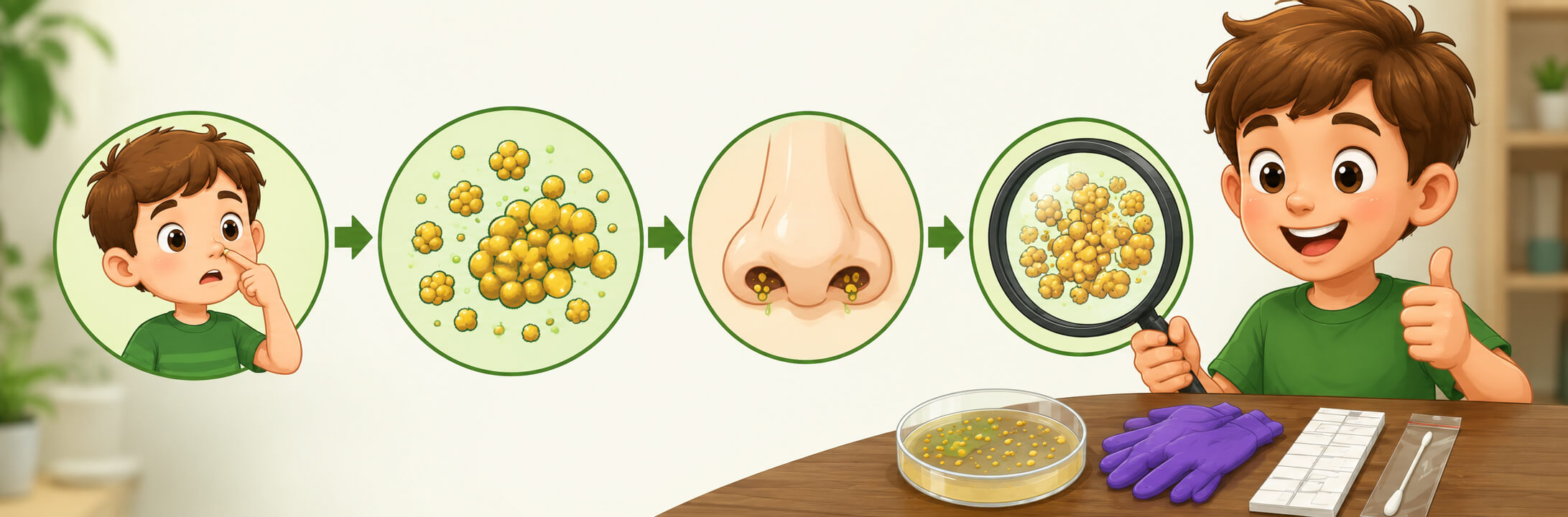
This is the marquee finding. It is also the reason we built Booger Kit the way we did.
In a 2006 study from Erasmus University Medical Center, researchers found that people who self-reported as frequent nose pickers were significantly more likely to test positive for Staphylococcus aureus in their nose, and they carried higher amounts of it. The study concluded that overcoming the nose-picking habit may aid Staph decolonization. In plain English: the more a person picks, the more Staph they tend to carry.
Read the Wertheim 2006 study on nose picking and nasal carriage of S. aureus (Infection Control & Hospital Epidemiology, PMID 16874648).
A more recent 2022 study published in JAC-Antimicrobial Resistance reported an even sharper finding. The habit of nose picking was associated with Staph carriage at an odds ratio of 14.6, meaning nose pickers in the study were roughly 14 times more likely to carry the bacteria than non-pickers.
Read the Lamichhane 2022 study on Staph carriage and nose picking (Oxford Academic, JAC-Antimicrobial Resistance).
For broader context, the CDC notes that Staph commonly lives on the skin and inside the nose, and that many carriers never have symptoms. Read the CDC Staph and MRSA overview.
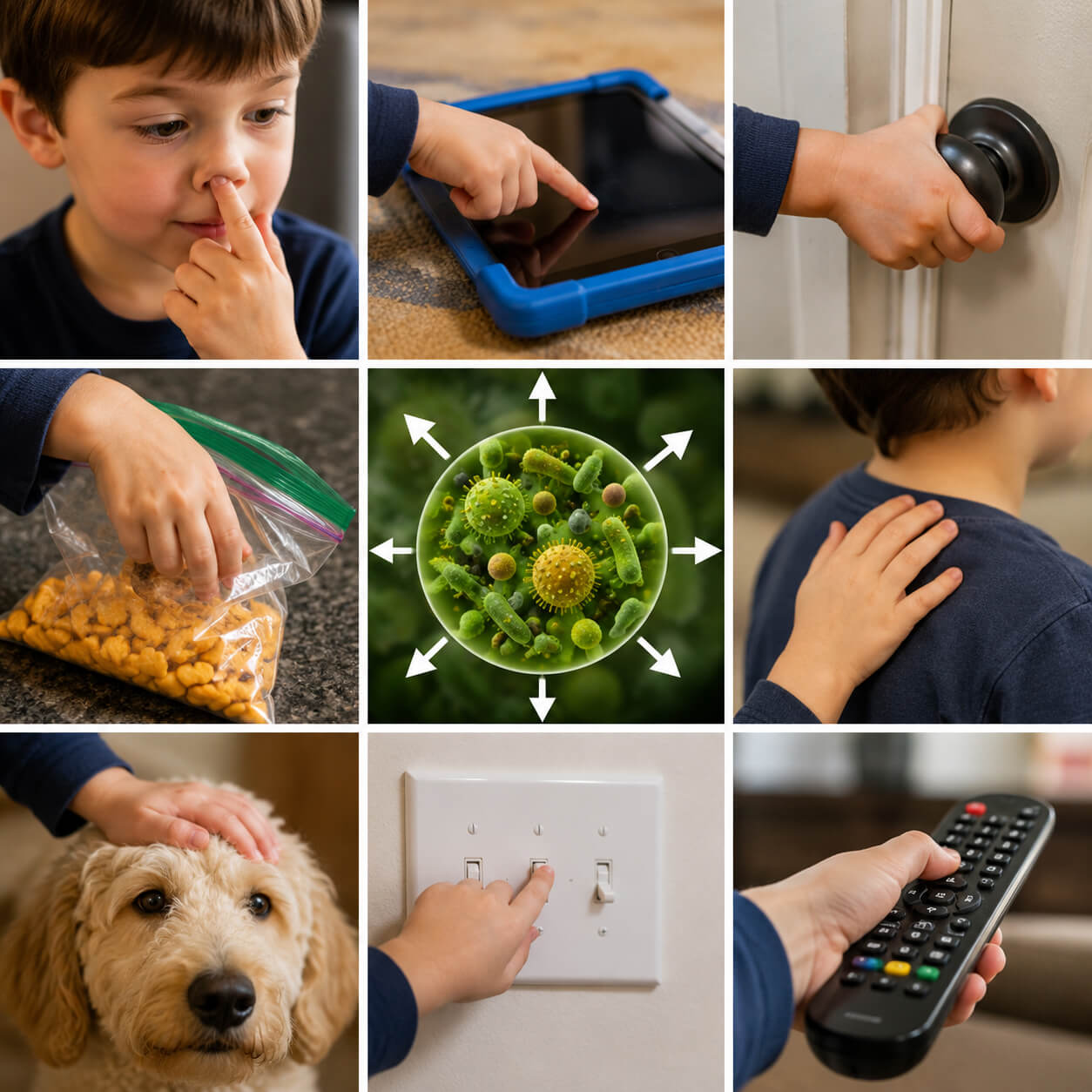
How Nose Germs Spread: From Finger to Family
Bacteria do not stay in the nose. The finger that was just inside the nose touches the iPad, the doorknob, the snack bag, the sibling, and the dog. Within minutes, whatever was upstairs is now on every surface in the house.
Households are unusually good at sustaining the spread of Staph. A primary study on community-associated MRSA documented household transmission patterns showing that close-contact home environments can cycle the bacteria among family members, with infection sometimes recurring after treatment because the home itself stays colonized.
Read the household MRSA transmission study (PMID 21617572).
The CDC’s prevention guidance on Staph and MRSA emphasizes that the bacteria spread mainly through contact with infected skin, contaminated surfaces or items, and poor hand hygiene, which is why hand-to-face contact is one of the most common transmission pathways for everyday illness. Read the CDC prevention guidance.
Why Seeing It Beats Hearing About It
If repeating “stop picking your nose” worked, no parent would ever need to repeat it twice. Yet here we are.
There is a reason for that, and it is supported by child development research. Kids learn habits and self-regulation better when adults give them structure and autonomy support, which means helping them understand what is happening and giving them a stake in the outcome, instead of relying on commands or punishment. A 2024 study published on PubMed documented exactly this pattern in toddler cooperation: structured, autonomy-supportive parenting beat controlling approaches.
Read the toddler cooperation and autonomy support study (PMID 39403829).
There is also direct hygiene-behavior research showing that vivid, emotionally-charged messaging beats neutral education. A study on hand hygiene found that disgust-enhanced messaging produced significantly better handwashing behavior than standard educational content. Showing kids what is on their hands works better than just telling them.
Read the disgust and hand hygiene study (PMID 19181428).
Booger Kit was built around exactly this principle. We are not claiming the kit has been clinically tested as a branded intervention. What we are saying is this: the kit turns an invisible hygiene problem into a vivid, hands-on, kid-led experiment. Parents tell us that lecture-fatigue stops working long before the petri dish on the kitchen counter does, and the research on how kids actually learn supports why.
Frequently Asked Questions
Are nose pickers more likely to carry Staph bacteria?
Yes. Peer-reviewed research has linked nose picking to higher rates of Staphylococcus aureus nasal carriage. A 2006 study from Erasmus University Medical Center found significantly higher carriage rates among nose pickers. A 2022 study published in JAC-Antimicrobial Resistance found that nose pickers had an odds ratio of 14.6 for carrying S. aureus compared to non-pickers, meaning they were roughly 14 times more likely to carry the bacteria.
Is nasal mucus part of the immune system?
How common is nose picking in children?
Can nose picking spread germs to the rest of the household?
Bacteria from the nose can transfer to fingers and from there to surfaces, devices, food, and other people. Household transmission of Staphylococcus aureus has been documented in peer-reviewed research, and the CDC identifies hand-to-surface contact as a major route for everyday illness transmission.
Why does showing kids the bacteria in their nose work better than telling them to stop picking?
Child development research shows that kids learn behaviors better through structure and autonomy support than through commands or punishment. Hygiene-behavior studies have also shown that vivid, emotionally memorable messaging produces better handwashing behavior than neutral education. Visible evidence of bacteria turns an abstract warning into a concrete experience the child remembers.
From Research to Reality
Most kid hygiene products lecture. Booger Kit shows. The science behind that approach is not a marketing claim. It is six different bodies of peer-reviewed research, layered on top of each other, all pointing in the same direction: kids need to see something to truly understand it, and the nose is one of the most important things on a child’s body to actually understand.
Ready to see what is living inside your kid’s nose? Order your Booger Kit today and run the experiment yourself.
Full Reference List
- Mucociliary clearance review (PubMed, 2023, PMID 37974723)
- Mucin gene expression in nasal mucosa (PubMed, PMID 16143194)
- Antibacterial activity in human nasal secretions, including lysozyme and lactoferrin (PubMed, PMID 7792436)
- Human beta-defensin 2 in nasal mucosa (PubMed, PMID 14504864)
- A Preliminary Survey of Rhinotillexomania in an Adolescent Sample (PubMed, PMID 11465519)
- Epistaxis clinical review (NCBI Bookshelf, NBK435997)
- Wertheim et al., Nose Picking and Nasal Carriage of Staphylococcus aureus (PubMed, PMID 16874648)
- Lamichhane et al., Staph carriage and nose picking, JAC-Antimicrobial Resistance, 2022
- CDC Staph and MRSA overview
- Household CA-MRSA transmission study (PubMed, PMID 21617572)
- CDC Staph and MRSA prevention guidance
- Toddler cooperation and autonomy support study (PubMed, PMID 39403829)
- Disgust and hand hygiene study (PubMed, PMID 19181428)