

Bacteria Science Fair Project for Kids: Easy, Gross, and Ready Out of the Box
- Updated: November 7, 2026
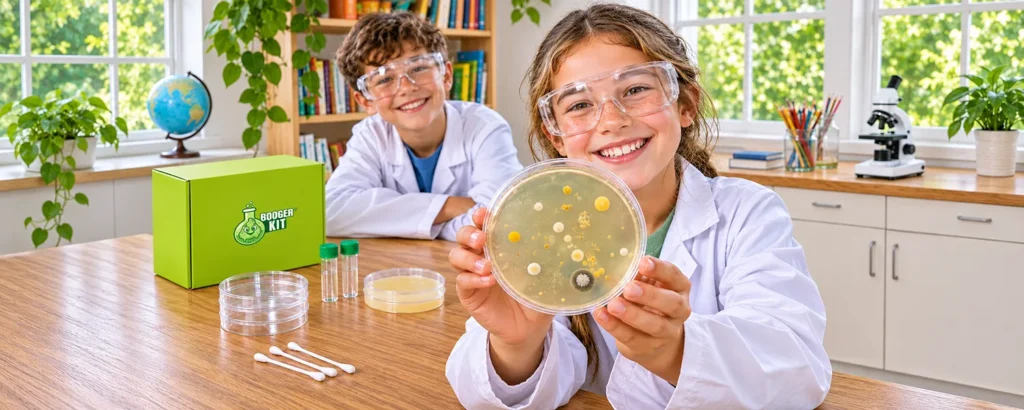
It’s science with a generous helping of gross. And the starting material is conveniently located on your child’s face.
An Easy Science Fair Project That Starts With "Ew"
Somewhere between the science fair announcement and the trip to buy poster board, every parent asks:
“What can we do that’s interesting without making this our entire weekend?”
You want something manageable. Your kid wants something cool. Booger Kit is both. Open the box, an adult swabs, your kid streaks, seal the dish, and start documenting. The bacteria science fair project is already built. Your child just records what happens day by day.
At first, there’s nothing to see. Then a tiny spot appears. Then another. Suddenly, checking the science project becomes something your kid asks to do.
Possibly before breakfast. You’ve been warned.
Booger Kit at a Glance
- Project type: Bacteria science fair project (observation and photo log)
- Ages: 5 and up, with adult supervision
- Time to first growth: Usually 2 to 4 days
- Observation period: Up to 10 Growth Days, with adult disposal no later than 14 days after sealing
- What’s included: Everything needed for the experiment
- Price: $29.99 with free shipping
What Comes in the Box
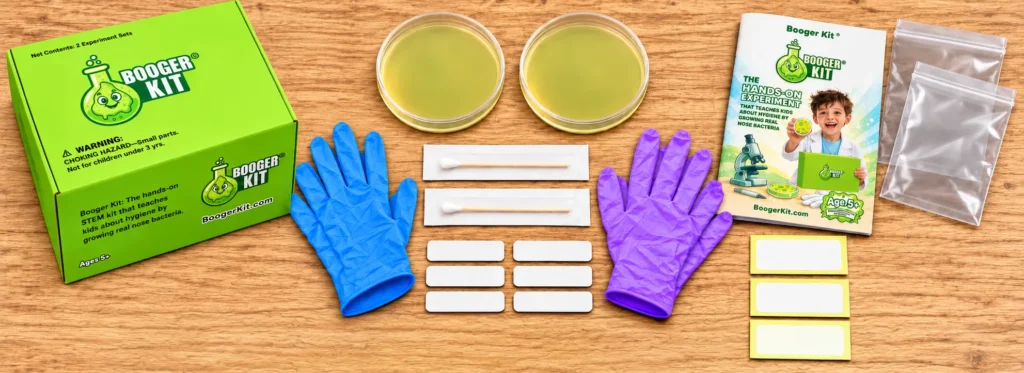
Everything for a growing bacteria science fair project is included:
- Two pre-poured agar petri dishes
- Two sterile swabs
- Kid and adult gloves
- Fastening strips and dish labels
- Disposal supplies
- A step-by-step instruction booklet
No mixing agar. No pouring dishes. No hunting down lab supplies at four different stores.
For the display, add a phone or camera, a notebook, and a poster board.
How the Booger Kit Bacteria Science Fair Project Works
1. Ask the Question
What grows from inside my nose, and how does it change each day?
2. Make a Prediction
Before swabbing, have your child guess:
- How many days until the first visible spot?
- Will there be a few big colonies or lots of little ones?
- Will they all look alike?
- What colors might appear?
Write it down. Finding out you guessed wrong is one of the best parts of science.
3. Swab, Streak, and Seal
Follow the instruction booklet. An adult gently swabs just inside your child’s nose, your child streaks the sample across the agar, and you seal and label the dish. Once sealed, the dish stays sealed throughout observation and disposal.
4. Document Day by Day
Photograph the sealed dish at the same time each day, with the same lighting and camera angle. Then fill in a simple log:
| What to Record | What to Look For |
|---|---|
| First visible growth | When did the first spot appear? (That's Growth Day 1.) |
| Number of colonies | How many separate spots can you count? |
| Color | Are they all the same color? |
| Shape and size | Round, fuzzy, tiny, or spreading? |
| Daily changes | What looks different from yesterday? |
The dish doesn’t identify which microbes grew. Your child’s job is to describe what they see.
5. Compare Results to the Prediction
Was the timing close? Were there more colonies than expected? What was the biggest surprise? A few sentences answering those questions becomes the conclusion.
Build a Petri Dish Display That Gets Attention
Title it “What’s Growing in My Nose?” and watch people stop walking.
Then organize the board into five sections:
- My Question: What did I want to find out?
- My Prediction: What did I think would happen?
- My Method: How did I collect the sample and record changes?
- My Results: Daily photos plus the observation log
- My Conclusion: How did the results compare with my prediction?
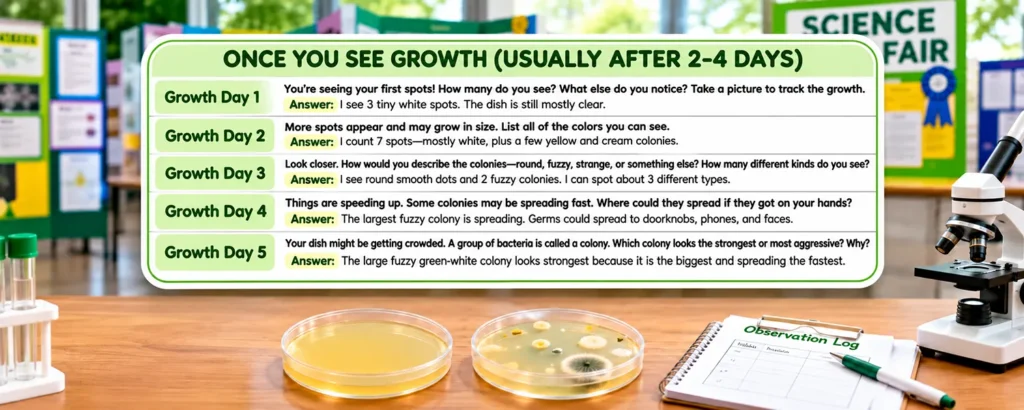
Make the photo timeline the centerpiece. Day-by-day photos are what bring a petri dish science fair project to life. When the project is done, share your kid’s best photo in the Booger Gallery.
The photos go to the fair. The dish stays home, sealed, until an adult disposes of it.
Why Their Own Nose Makes It a Memorable Germ Project
Kids hear about germs all the time. Wash your hands. Use a tissue. Keep your fingers out of your nose.
With Booger Kit, the sample comes from them.
“That was in MY nose?”
There’s your opening. Booger Kit is designed to help kids stop picking their nose by making the invisible visible. The project also opens up a conversation about how fingers move microbes between noses, hands, and everything we touch. And fair warning: the adults usually end up checking the dish too.
Want to explore more ways to teach kids about germs? Read our germ science experiment guide, or dig into the science behind Booger Kit.
How Long Does the Booger Kit Bacteria Science Fair Project Take?
Growth usually appears in 2 to 4 days, so start at least a week before the fair. The first day of visible growth is Growth Day 1. Kids can observe for up to 10 Growth Days, with adult disposal no later than 14 days after sealing, whichever comes first.
Daily work is one photo and a few notes. That’s manageable alongside homework, practices, and everything else on the family calendar.
Bacteria Science Fair Project FAQ
Can kids grow bacteria for a science fair project?
Yes. A bacteria science fair project is a classic elementary pick. With Booger Kit, kids document growth with daily photos. The photos go to the fair, and the sealed dish stays home.
Is Booger Kit a complete bacteria science fair project?
Yes. The dishes come pre-poured with agar, and the kit includes everything for the experiment plus step-by-step instructions. Your child adds daily photos, an observation log, and a display board.
Is this a good bacteria science fair project for elementary school or kindergarten?
Yes. Booger Kit is designed for kids 5 and up with adult supervision. Younger kids can draw and describe what they see. Older kids can count colonies, track changes, and build a full photo timeline.
What grows on the dish?
Microbes from the nose, which can include bacteria and sometimes fungi, grow into visible colonies of different colors and shapes. The dish doesn’t identify which microbes grew, so treat the contents as potentially harmful and keep the dish sealed.
Is it gross enough to be a memorable science fair project?
It’s a booger experiment. Gross is the whole point, and it’s the reason people stop at the display.
How much does Booger Kit cost?
Booger Kit is $29.99 with free shipping.
When should I order Booger Kit for a science fair project?
Order at least 3 weeks before your fair. Kits ship 2 to 3 days after you order, and delivery usually takes 2 to 7 days. Growth usually appears 2 to 4 days after swabbing, and your child will want several days of photos for the display board.
Give Them Something Gross to Discover
An easy bacteria science fair project can still give your child plenty to investigate, photograph, and explain. Booger Kit brings the supplies. Your kid brings the nose.
And when someone asks where the idea came from, your kid gets to point to their face.