
Booger Kit® FAQ
We’ve answered the most common questions parents ask about using the Booger Kit. If you don’t see your question here, we’re happy to help!
Real Science
Grow real bacteria from your nose in a safe, hands-on experiment.
Safe & Kid-Friendly
Designed for kids ages 5–11 with adult supervision.
Build Better Habits
Turn nose-picking into a positive lesson about hygiene.
Fun & Educational
A science experiment they’ll love that parents can feel good about.
Browse FAQs by Topic
Click a topic below to jump to those questions.
About Booger Kit
Who created Booger Kit?
Sean Stafford, a dad of two daughters in Louisville, Kentucky. Booger Kit is a family business.
The idea came during a school play, when Sean noticed how many kids in the room were absentmindedly picking their noses. Like every parent, he had spent years saying "stop picking your nose," and realized in that moment that kids had never actually seen the germs everyone kept talking about.
His daughters have always loved science kits, so the answer was obvious once he saw it. Build the experiment that finally makes germs visible, and let the dish do the talking. Visit Our Story page.
Does Booger Kit really help stop nose picking?
Booger Kit does not promise to stop nose picking. What it does is give kids something they have never had before: visible proof that germs really exist.
Here is the problem every parent runs into. "Germs" is an abstraction. We tell kids that germs can come from boogers, that picking their nose gets germs on their hands, and that germs are why we wash our hands. The problem is that a child has never seen a germ. There has never been a good way to show them. Until now.
This experiment turns germs into something a five year old can point at. Their own bacteria, from their own nose, growing on a dish with their own name on it. That is a visual reason not to pick, instead of a rule.
Every child is different and no product can guarantee a habit changes. What this one does is finally unlock the visual, and that changes the conversation from a parent talking about what germs are into showing what germs are.
How to Get My Kid to Stop Picking Their Nose: A Parent’s Guide That Actually Works
Why do kids pick their nose?
Is this a real science experiment?
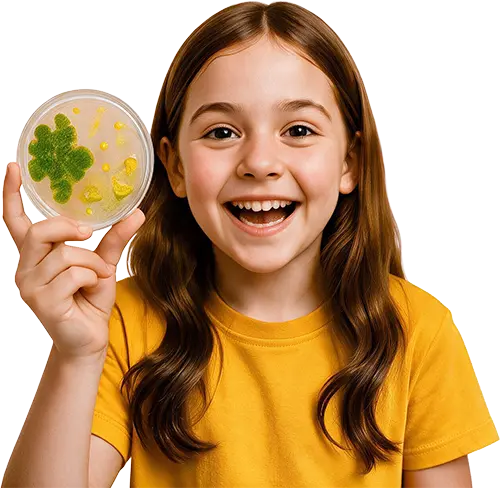
Yes. This is a genuine microbiology experiment using the same basic method a lab would use: a sterile swab, a nutrient agar plate, a controlled growth period, and recorded daily observations.
Nothing is simulated and nothing is pre-loaded. Whatever grows came out of your child’s own nose.
That is what separates Booger Kit from most science kits for kids, where the result is built into the box before it ships. Here, nobody knows what the dish will look like, including us.
Is this educational or just for fun?
Both, and there is a third thing underneath it.
The fun is what gets kids to sit still for two weeks of observation. The education is a full STEM activity, predicting, observing, recording data over time, and reaching a conclusion, with real microbiology along the way.
The third thing is what the whole kit was built for. Germs are invisible. Kids are told about them constantly and have never once seen one. This experiment makes them visible, grown from your own child’s nose, with their name on the label. A kid who has looked at that dish understands what is in their nose in a way no reminder can deliver.
Is this a medical kit or medical advice?
No. Booger Kit is a science and hygiene education product for kids. It is not a medical device, not a diagnostic test, and nothing on this site or in the instruction insert is medical advice.
The dish does not screen for illness, does not identify infections, and cannot tell you anything about your child’s health. Whatever grows is the normal bacteria that live in a nose, which is the point of the lesson.
If you have any concern about your child’s health, talk to your pediatrician. The kit is not a substitute for that conversation and was never designed to be one.
Can we use this for a science fair project?
It is built for one. Two dishes give you a variable, a control, a prediction, days of recorded observations, and a conclusion.
Comparisons that make strong projects:
- Left nostril versus right nostril
- Before handwashing versus after
- Nose swab versus a toothbrush handle
- Nose swab versus a household surface
- Kid versus grown-up
The observation chart in the insert is already structured this way: prediction, daily records, then compare and conclude. Photograph the dishes daily. That photo sequence is the centerpiece of the board.
Count backward from your due date and allow about two weeks for the experiment plus build time.
Can teachers use this in a classroom? Is there bulk pricing?
Yes. Two dishes per kit means you can run this hygiene science activity in pairs, in small groups, or as a whole class demonstration.
It fits units on microbiology, hygiene, the scientific method, and data recording, and it is the rare lesson students want to come back and check on the next day.
For bulk orders, classroom quantities, and school purchase orders, email info@boogerkit.com and we will work with you directly.
Usage and Reusability
How many times can I use the Booger Kit?
Two experiments per kit. Every kit includes two petri dishes, so you can compare left nostril to right nostril, run child against parent, or save the second dish for another day.
Each dish grows one sample and is used once. If you want to run more than two bacteria experiments, or have more than two kids, add the Booger Kit Upgrade Pack. When added to a Booger Kit box order, the Upgrade Pack ships free.
Is the Booger Kit reusable?
No. Each petri dish is single use. Once a dish has been sealed after swabbing, it is never opened or reused. When the experiment is finished, dispose of the sealed dish following the included instructions.
If you would like to run multiple bacteria experiments, go for the Upgrade Pack. It includes fresh petri dishes and swabs, and it ships free when added to a Booger Kit box order.
Can I buy extra Petri dishes?
Yes. The Booger Kit Upgrade Pack includes fresh pre-poured petri dishes and sterile swabs, so you can repeat the experiment as often as you like.
Can siblings share a kit?
Yes, with one rule. Each child gets their own sterile swab and their own dish. Swabs are never shared between kids, and an adult performs each swab.
With two dishes per kit, two siblings can each have one experiment. If you have more than two kids, or want everyone doing both nostrils, add an Upgrade Pack.
Sibling comparisons get competitive quickly, which works in your favor. Kids invested in the outcome check the dishes every morning.
Can I compare results between kids?
Yes, and it is the most interesting way to run it. Two dishes means a real side by side comparison rather than a single result.
An adult performs each swab. Label both dishes and have everyone predict which will grow more before you start. The observation chart in the instruction insert has a column built for exactly this.
One note for parents: more colonies does not mean that child is dirtier or less healthy. Every nose carries bacteria. What the comparison shows is that germs are real, they are everywhere, and they travel on hands.
Can I swab mine too, to compare?
Please do. Kid versus grown-up is one of the better matchups in the box.
Label one dish with each name, predict out loud, then swab. Most kids assume the adult dish will come back cleaner. It usually does not, because adults carry the same nasal bacteria kids do.
That result reframes the conversation. It stops being “you are gross” and becomes “this is true for all of us, which is why we all wash our hands.”
Can I swab something besides a nose?
Absolutely, and it makes the experiment better. Use one dish for a nose swab and the second for something else around the house.
Popular targets:
- A phone screen
- A doorknob
- A toilet seat
- A tablet or keyboard
- A favorite toy
- The TV remote
Kids almost always guess wrong about which will grow more, which is what makes it stick. Seeing germs on hands and everyday surfaces next to germs from a nose connects the whole hygiene lesson.
Same rules either way: an adult takes the swab, seals the dish immediately with the sealing strips, and it is never reopened.
Kit Contents
What is included in the Booger Kit?
Everything you need. Open the box and start the experiment.
- 2 sterile cotton swabs
- 2 pre-poured petri dishes with nutrient agar
- 6 sealing strips (three per dish)
- 2 label stickers
- 2 resealable plastic bags (the dishes arrive in these, and they are used again for disposal at the end)
- 1 instruction insert with directions, safety tips, and the observation chart
- 1 pair of kid size nitrile gloves
- 1 pair of adult size nitrile gloves
Bonus: the shipping box doubles as the incubator, so there is no extra equipment to buy.
What do we need at home?
Very little: A pen and a warm spot out of direct sunlight where the sealed dishes can sit undisturbed. You'll also need a grown-up to run the swab and supervise.
That is the list. The shipping box works as the incubator, so there is nothing extra to buy. Set it somewhere consistently warm, like the top of the refrigerator, away from heat vents and direct sunlight, and you are in business.
One optional thing that makes a real difference: take a photo each day. Day 1 looks like nothing. Flipping through the sequence at the end is usually when it clicks.
Are the Petri dishes safe?
The dishes are built around one rule: what grows inside is never opened or touched.
Each dish arrives pre-poured with nutrient agar, unopened and inside a sealed bag. An adult takes the swab, and then three sealing strips lock the lid down. Those strips are designed to be difficult to remove once placed. The dish stays sealed that way for the entire growth period. At the end, an adult places it back into the resealable bag it came in and throws it away.
The bacteria that grow are already living in your child’s nose. What changes inside the dish is the quantity, because agar gives them everything they need to multiply. That is why it stays closed.
Keep dishes away from food, pets, and younger siblings.
Can I touch the outside of the Petri dish while it is growing?
Yes. The outside of a sealed dish is fine to handle.
Pick it up by the edges and wash hands afterward as a matter of habit.
What does not happen is opening it. The three sealing strips stay on and the lid stays down from the moment the swab goes in until the dish goes in the trash.
Does the finished dish smell?
No. There shouldn't be any odor at all.
In the very uncommon event that you do notice an odor, something hasn't gone right.
Place the dish into one of the resealable bags, seal the bag, throw it away, and wash hands. Then please email info@boogerkit.com with your order number and a photo so we can help investigate.
Is anything in the kit an allergy risk?
We considered this when choosing components.
The gloves are nitrile, not latex. That was deliberate, since latex allergies are common in children.
The agar is a seaweed derived growth medium. It is bacteria food, not food for people, and is not meant to be eaten or touched with human hands.
The swabs are sterile cotton, individually wrapped. Dishes, strips, and bags are plastic. The box is cardboard.
If you have a specific allergy in mind, email info@boogerkit.com before you order and we will tell you what we know about that component.

Age & Safety
Who can use the Booger Kit?
Booger Kit is designed for kids ages 5 and up, with a grown-up performing the swab and helping throughout.
The elementary years are the sweet spot. That is when a child is old enough to follow one simple rule about a sealed dish and patient enough to stay with a multi-day experiment.
Older kids get plenty out of it too, and middle schoolers often take this microbiology experiment straight to the science fair.
If your child has a compromised immune system or a specific medical condition, check with your pediatrician first.
Is it safe for kids?
Booger Kit is designed for ages 5 and up, with a grown-up performing the swab and handling the cleanup.
Four things carry the safety design:
- An adult takes the swab. Each child gets their own sterile swab, and swabs are never shared.
- Three sealing strips lock the lid down right after swabbing, and the dish is not opened again.
- Nitrile gloves are included for the child and the adult.
- At the end, an adult places the sealed dish into the resealable bag it came in and throws it away.
Hands get washed before and after, and dishes stay out of reach of pets, food, and younger siblings.
If your child has a compromised immune system or a specific medical condition, check with your pediatrician first.
Is parental supervision required?
Yes, absolutely. And not just for the swab.
An adult performs the swab, applies the sealing strips, and handles disposal at the end. Those are the safety requirements and they are not optional.
But the daily check is where this kit actually earns its keep, and you want to be there for it. When your child spots the first specks and then watches them turn into full colonies, that is the moment they are ready to talk about it. What is that? Where did it come from? Is that really from my nose?
That conversation is the entire point of the product. It is the best opening you will ever get to talk about boogers, germs, and why picking is not a great idea, because your child is the one doing the asking.
What if my child opens the dish?
It is not easy to do. Each dish is locked down with three sealing strips that are intentionally designed to be difficult to remove once placed.
If it does happen, handle it calmly. Put on the adult gloves, place the dish and lid into one of the resealable bags, seal the bag, and throw it away. Wash hands thoroughly with soap and warm water, then wipe the surface with a household disinfectant.
The best prevention is setting the expectation up front that the dish stays closed once sealed. Kids follow that well when they know it is part of how the experiment works.
Email info@boogerkit.com within 30 days of delivery and we will help you get set up again.
What actually grows in the dish?
The ordinary residents of a normal human nose. Typically:
- Staphylococcus epidermidis (a common skin bacterium). Small, round, creamy white.
- Corynebacterium species (diphtheroids). Small and dry looking.
- Micrococcus species. Often yellow or gold, always the crowd favorite.
- Staphylococcus aureus (commonly carried in the nose). Frequently golden.
- Pink or rose-colored colonies, which usually come from pigment producing environmental bacteria or yeasts.
Two things worth knowing. The dish is not a test and does not diagnose anything. These organisms are already in every nose in your house, and the dish shows what is normally there. And this is why it stays sealed, since inside a dish full of agar these populations multiply well past what a nose carries.
The Science Behind Booger Kit
Why doesn’t my child get sick from the bacteria already in their nose?

Experiment Timeframe
How long does the experiment take?
About 12 to 14 days from the day you swab to the day you throw the dish away.
It breaks into two parts. First there is a waiting stretch of roughly two days where nothing is visible on the dish. Then, once the first specks appear, the ten day growth log in the instruction insert begins. Growth Day 1 starts when you can see something, not when you swab.
Here is the part most people have backwards. The bacteria do not sit still during those first two days. They begin dividing within hours of reaching the agar. What takes two days is becoming large enough for the eye to see, because a single visible dot represents an enormous number of bacteria stacked together.
Which is the whole lesson. Something is happening the entire time because bacteria are alive.
When will I see results?
Expect about two days of nothing, then ten days of steady change.
The first stretch is the patient part. Nothing appears on the dish for roughly two days while the bacteria multiply below the threshold of what an eye can pick up.
Once the first specks show up, the growth log begins:
- Growth Days 1 to 2: tiny specks, smaller than a pinhead
- Growth Days 3 to 5: colonies enlarge and take on distinct shapes
- Growth Days 5 to 8: colors develop, often yellow, gold, or pink
- Growth Days 8 to 12: colonies reach full size and eventually stop changing
Warmth speeds this up and a cool room slows it down, so your days may shift either direction. Record what you see each day on the chart rather than checking once at the end. Watching it change over time is the science.
What if I do not see anything growing?
The most common reason is temperature. Bacteria grow slowly in a cool spot, and most houses have cold corners nobody thinks about. Move the dish somewhere warmer and give it more time. That fixes most quiet dishes.
Other possibilities:
- The swab was too light. It needs a few seconds of firm contact inside the nostril.
- Recent antibiotics or a very dry nose can mean less to collect.
- It has not been long enough yet. Nothing is visible for about the first two days.
Do not open the dish to check.
Also worth telling your child: a nearly empty dish is a real result, not a failure. It is data. Scientists get surprising results constantly.
If both dishes stay blank at the end, email info@boogerkit.com and we will help you troubleshoot.
Can I refrigerate the dishes?
Not during the experiment. Cold slows bacterial growth dramatically, so a refrigerated dish may show very little or nothing at all.
Before you start, an unopened kit stores fine at normal room temperature. No refrigeration needed.
Once a dish is swabbed and sealed, warmth is what you want. A stable warm spot indoors, out of direct sunlight, for the full growth period.
How do we throw everything away when we are done?
Dishes should be thrown away no more than fourteen days after the day you swabbed. Mark that date on your calendar when you start.
The disposal itself is quick. A grown-up puts on the adult gloves, places the sealed dish into the resealable bag it originally came in, seals the bag, and puts it in household trash. Wash hands.
The sealing strips stay on. The dish never gets opened, never gets recycled, and nothing gets flushed.
Full disposal steps are printed in the instruction insert.
How long can we keep the finished dish?
No more than fourteen days from the day you swabbed, and then it goes in the trash. That is the end of the experiment.
We know your child is going to ask to keep it. They grew it and it has their name on it. The answer is still no. A sealed dish is safe because it is sealed, and a dish sitting on a shelf indefinitely eventually gets bumped, dropped, or picked at.
Take photographs instead. A start to finish photo sequence is a better keepsake than a plastic dish. It is the version your child will actually show people, and it is what goes on a science fair board.
Understanding Your Results
Will every dish look the same?
No, and that is the best part. Every dish is different because every nose is different.
Two children in the same house, swabbed on the same day, will grow different patterns. So will the same child’s left and right nostril.
Number of colonies, size, shape, and color all vary based on what was collected, how warm the dish stayed, and what happens to be living in that particular nose that week.
There is no right answer to compare against. Whatever grows is your child’s result.
Why are some colonies different colors?
- Yellow or gold usually comes from Micrococcus or Staphylococcus species that produce carotenoid pigments, the same family of compounds that make carrots orange.
- Creamy white is often Staphylococcus epidermidis.
- Pale or dull colonies are frequently Corynebacterium.
- Pink or rose colonies typically come from pigment producing environmental organisms. Two common candidates are Kocuria rosea (formerly called Micrococcus roseus), a rose-colored bacterium found on skin and in dust, and Rhodotorula, a pink yeast common in air and damp places. If you swabbed a bathroom surface, pink can also come from Serratia marcescens, the environmental bacterium responsible for the pink film that shows up in showers and around drains.
Why did one dish grow more bacteria than the other?
Usually one of three reasons, and working out which one is the actual experiment.
Swab technique matters most. A firm swab collects far more than a quick tap, so small differences between one swab and the next show up clearly.
Temperature matters next. A dish in a warmer spot grows faster than one a few feet away in a cooler draft.
And genuine differences exist between people, and even between nostrils.
What it does not mean is that one person is dirtier. Have your child write down which explanation they think is right. That is scientific reasoning.
Does washing hands change the results?
It can, and it makes an excellent second experiment.
Swab a fingertip before handwashing onto one dish, then have them wash thoroughly with soap and warm water and swab a fingertip onto the second. Seal both and compare.
Most families see a clear difference, which is a stronger argument for handwashing than being told to do it.
Worth noting for accuracy: handwashing removes germs on hands. It does not change what lives inside the nose. That distinction explains exactly why the nose picking habit moves germs around in the first place.
What if mold grows?

Shipping and Support
What are the shipping options and costs?
We offer free shipping on every order of $29.99 or more, anywhere in the United States, including Alaska and Hawaii, so every Booger Kit order ships free.
Upgrade Packs added to a Booger Kit order ship free in the same box. One or two Upgrade Packs ordered on their own ship for a flat $8.99. Three or more on their own reach $29.99 and ship free.
Orders typically ship within 2 to 3 days, and delivery usually takes another 2 to 7 days after that.
We do not ship internationally at this time.
What if something arrives damaged?
We will make it right. Email info@boogerkit.com within 30 days of delivery with your order number and a photo of the damaged component, and we will send a replacement free.
You do not need to ship anything back and there is no form to fill out.
What if a dish arrives cracked?
Do not use it. A cracked dish will not seal properly, and the seal is the entire safety design.
Place the cracked dish into one of the resealable bags, seal it, and throw it away.
Then email info@boogerkit.com within 30 days of delivery with your order number and a photo of the cracked dish before you toss it. We will send a replacement at no charge and nothing needs to be shipped back.
What if the kit sits in a hot mailbox or a freezing porch?
It is fine. The dishes ship unopened, unswabbed, and inside a sealed bag, so a day of temperature swing will not affect the experiment. Bring the kit inside and let it reach room temperature before starting.
The one thing to avoid is running the experiment somewhere with wide temperature swings. Once a dish is swabbed and sealed, give it a stable warm spot indoors and leave it alone.
How do I contact support?
Email info@boogerkit.com and a real person will write you back.
You can also visit our support page for order questions, replacement parts, returns, and refunds.
If something arrived damaged, include your order number and a photo. That is usually all we need to get a replacement moving.