
Nose Picking Deterrents: Why Most Fail and What Works Instead
If you are searching for nose picking deterrents, chances are you have a little one at home who has already outsmarted everything you have tried. You are not alone and you are not failing as a parent. The deterrents failed. There is a difference.
Understanding why they failed is the first step toward finding something that actually works.
The Psychology Behind Why Nose Picking Deterrents Don't Work
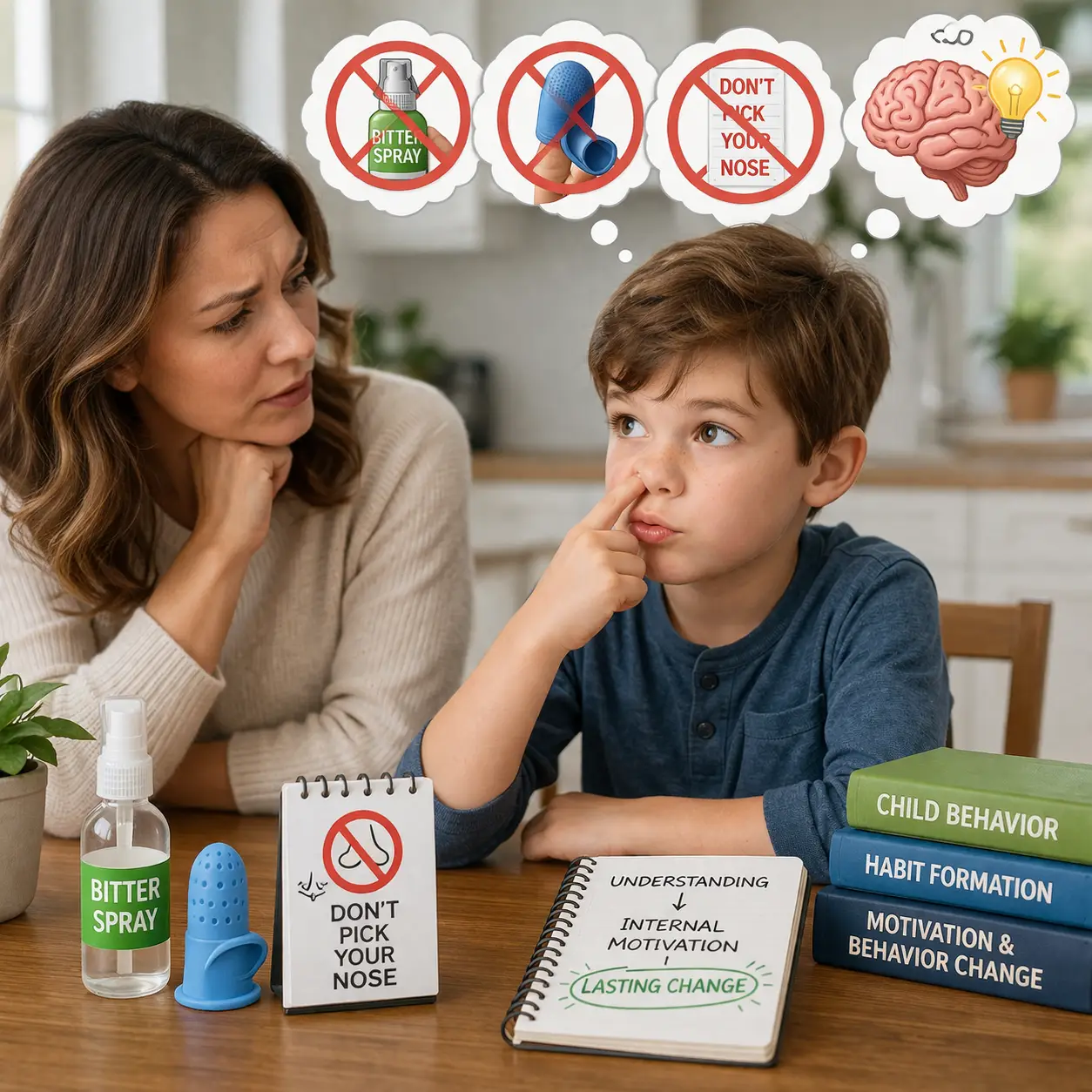
Behavioral science has a name for what most nose picking deterrents attempt: aversive conditioning. The idea is simple. Pair an unwanted behavior with an unpleasant stimulus and the behavior decreases. It works on lab rats. It works on adults in certain controlled settings. It works poorly on children in real world conditions.
Here is why.
Aversive conditioning requires the unpleasant stimulus to be present every single time the behavior occurs. Miss one instance and the association weakens. Miss several and it breaks down entirely. A child who picks their nose at school, in the car, in bed at night, or any of the dozen other moments when no deterrent is present, is reinforcing the habit far more often than the deterrent is discouraging it.
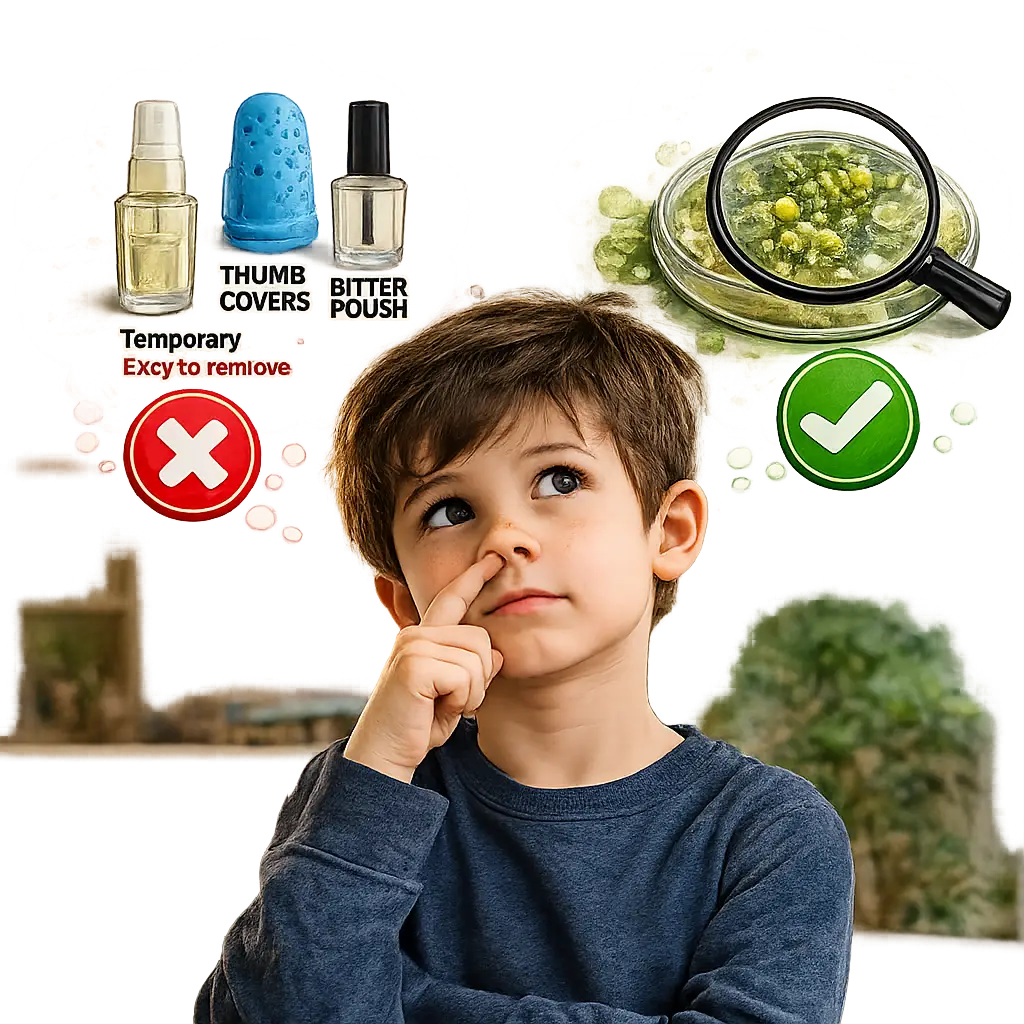
The second problem is adaptation. Children are remarkably good at habituating to aversive stimuli. Bitter nail polish stops tasting as bitter after a few days. A reminder sticker becomes invisible after a week. The brain is wired to filter out stimuli that repeat without consequence, and children’s brains are especially efficient at this process.
The third and most fundamental problem is that deterrents address behavior without addressing belief. A child who stops picking their nose because something tastes bad has not learned anything. They have simply been temporarily inconvenienced. The moment the inconvenience disappears, so does the compliance.
Lasting behavior change in children requires a different mechanism entirely.
What Actually Changes Behavior in Children
Research in developmental psychology consistently points to the same conclusion: children who understand the reason behind a rule are dramatically more likely to follow it than children who are simply told to comply or physically prevented from doing otherwise.
This is not a new finding. It has been replicated across decades of research on everything from handwashing to seatbelt use to dietary habits. The mechanism is called internalization. When a child genuinely owns the belief that a behavior is harmful, they regulate that behavior themselves. No external deterrent required.
The challenge with nose picking has always been making the consequences visible. A child cannot see the bacteria on their fingers. They cannot see the germs transferring to their food or their sibling’s face. The consequences are invisible and therefore unconvincing.
Until now.
Booger Kit: The Nose Picking Deterrent Built on Internalization
Booger Kit is a hands-on STEM science kit that makes the invisible visible. Instead of making nose picking unpleasant, it makes the consequences of nose picking impossible to ignore.
Your child swabs the inside of their own nostril with a sterile swab, then streaks that sample across a petri dish filled with nutrient agar. Over the next several days they watch as their own nose bacteria grows into visible colonies in real time.
When a child sees what was living in their nose actually growing in a dish they can hold in their hands, the internalization happens naturally. That is the bacteria that goes on their hands. That is what goes on everything they touch. That is what ends up in their mouth.
No deterrent. No aversion. No repetition required. Just understanding.
What's Inside Booger Kit
Booger Kit comes with everything needed to run the experiment from start to finish:
- 2 petri dishes pre-filled with nutrient agar
- 2 sterile swabs for sample collection
- 2 pairs of disposable gloves
- 6 clear fastening strips to seal the dishes
- 2 labels to name and date your bacteria colony
- 2 disposal bags for safe cleanup
- A full step-by-step illustrated guide
The box itself serves as the incubator. No extra equipment needed.
The Science Behind the Nose Picking Habit
Your nose produces about a quart of mucus every single day. That mucus traps bacteria, viruses, dust, and pollen before they can enter your lungs. Every time you pick your nose, those trapped particles move from your nose to your fingers to everything you touch.
Studies have found that nose pickers carry higher rates of nasal Staphylococcus aureus, a bacteria linked to skin infections and respiratory illness. Research has also identified nose picking as a significant risk factor for transmitting this bacteria to others in the same household.
When a child understands these facts and then sees the evidence growing in their own petri dish, the belief changes. Not because you told them. Because they proved it themselves.
Why Booger Kit Succeeds Where Every Nose Picking Deterrent Has Failed
Booger Kit works because it targets the root of the behavior rather than the behavior itself. It does not make nose picking harder. It makes not picking an obvious choice.
Kids as young as five can complete it with adult supervision. The experiment runs over several days, building anticipation and engagement with every check. The included observation journal turns the experience into a school-worthy science project. And the conclusions the child draws are entirely their own.
That is the difference between a deterrent and a solution.
Frequently Asked Questions
Why do nose picking deterrents stop working?
Most deterrents rely on aversive conditioning, which requires the unpleasant stimulus to be present every time the behavior occurs. Children adapt quickly to repeated stimuli, and any gap in application allows the habit to reinforce itself. More fundamentally, deterrents change behavior without changing belief, which means compliance ends the moment the deterrent is removed.
What actually works to stop nose picking in kids?
Behavioral research consistently shows that internalization produces more lasting change than external deterrents. When children understand the genuine consequences of a behavior through their own direct experience, they are far more likely to self-regulate. Booger Kit produces that understanding by making nose bacteria visible and tangible.
At what age should I address nose picking?
Nose picking typically begins around age two or three. Educational intervention is most effective between ages four and ten when children can engage with cause and effect reasoning. Booger Kit is designed for ages five and up with adult supervision.
Is Booger Kit safe for young kids? Yes. Booger Kit is designed for children ages five and up under direct adult supervision. The petri dishes are sealed after inoculation and never reopened. The kit includes disposable gloves, a disposal bag, and detailed safety instructions for every step of the experiment.